
Are you a mod or a rocker?
March 27, 2026 at 6:07 PM by Dr. Drang
I’ve been working my way slowly through Reingold and Dershowitz’s Calendrical Calculations. This week I hit Chapter 11 on the Mayan and Aztec calendars and came across a notation for modulo arithmetic that wasn’t familiar to me.1 I figured I’d write about it here on the off-chance that any of you would find it interesting. Also, to make it stick in my head a little better.
The notation came up in the section on the Haab calendar, a sort of solar calendar that the Mayans used along with the Tzolk’in and Long Count calendars. The Haab calendar has 18 months of 20 days each and then a 19th sort-of-month with just 5 days. There’s no year number in the Haab calendar, so there’s no way to convert directly from the Haab calendar to other calendars. But there is a way to get a date in another calendar that’s on or nearest before a given Haab date.
Reingold and Dershowitz use a “fixed” or “RD” calendar as their way station between all the calendars. It’s a single day number that counts up from what would have been January 1 of the Year 1 in the Gregorian calendar if the Gregorian calendar had existed back then. In this system, 0001-01-01 is Day 1 and today, 2026-03-27, is Day 739,702.
The function that finds the closest given Haab date on or before a given fixed date is called mayan-haab-on-or-before, and it’s defined this way in the text:
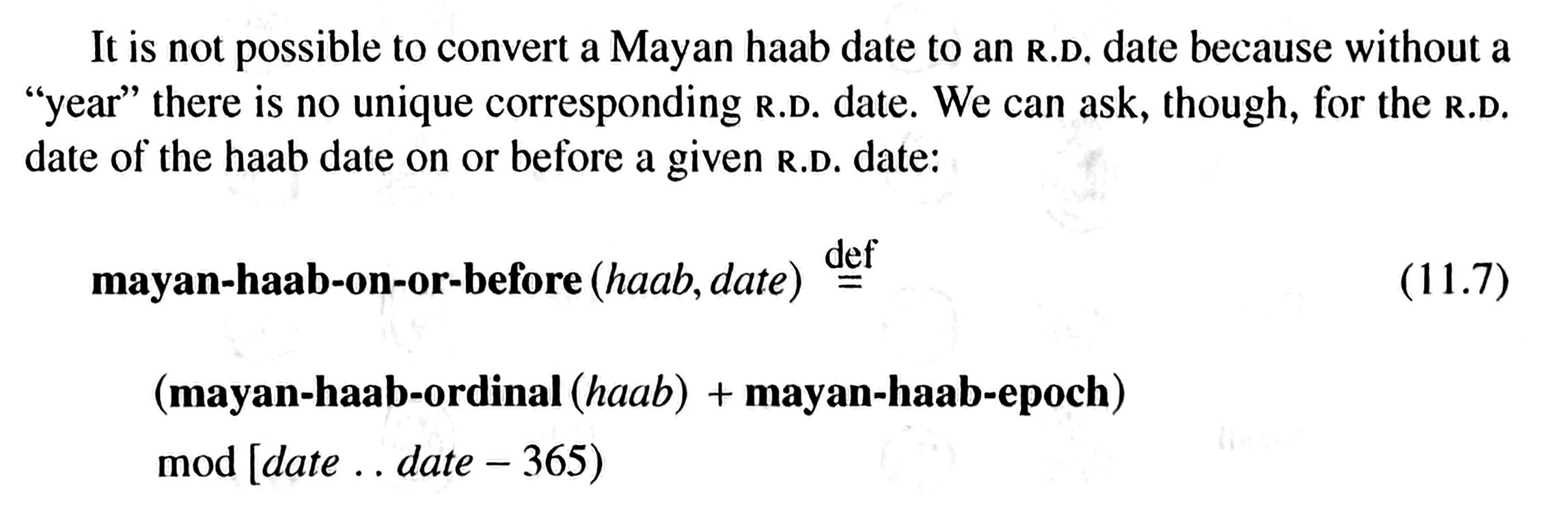
What’s odd about the modulo notation in this definition is that the thing after “mod” isn’t a divisor, it’s an interval: the half-open interval between date (inclusive) and date – 365 (exclusive).
Here’s how R&D define this interval modulus, both in Chapter 1 of Calendrical Calculations and in this ACM paper:
As long as the two ends of the interval aren’t identical, the answer will lie in the range . This notation is helpful in shifted modulo operations like the one in mayan-haab-on-or-before because it explicitly tells you the range of answers you’ll get. The idea is that the resulting fixed date will be anywhere from 0 (inclusive) to 365 (exclusive) days before the given date.
(The normal modulo notation, , could be written as , although this doesn’t seem particularly helpful.)
Note that in mayan-haab-on-or-before, the interval goes backward, which means the divisor in the standard mod function is a negative number: –365. If you’re implementing this function in a programming language, you have to make sure that using a negative divisor in your language’s mod will give you a negative answer. This means that mod must have a floored definition. The mod function in Lisp, which R&D are using, and the % operator in Python, which I’m using as I reimplement R&D, both use the floored definition.
I mentioned earlier that the 19th month of the Haab calendar is an oddball because it has only 5 days. As it happens, today is smack in the middle of that 19th month, which is called Wayeb or Uayeb, depending on whose transliteration you use.
Another odd thing about the Haab calendar—something that computer programmers must love—is that the day numbers within a month start at 0, not 1. So Monday, which is the start of the next Haab cycle, will be 0 Pop, Pop being the name of the first Haab month.
-
It would have been familiar if I’d read Chapter 1 carefully instead of skimming, but I was eager to get past the preliminaries quickly and figured I could always go back to Chapter 1 if necessary. Which it was. ↩