
Hardware vs. software
March 19, 2026 at 1:28 PM by Dr. Drang
I’ve been thinking about the new Apple Studio Display lately, mainly in the context of Jason Snell’s review of it on Six Colors and his further discussion with Myke Hurley on Upgrade.
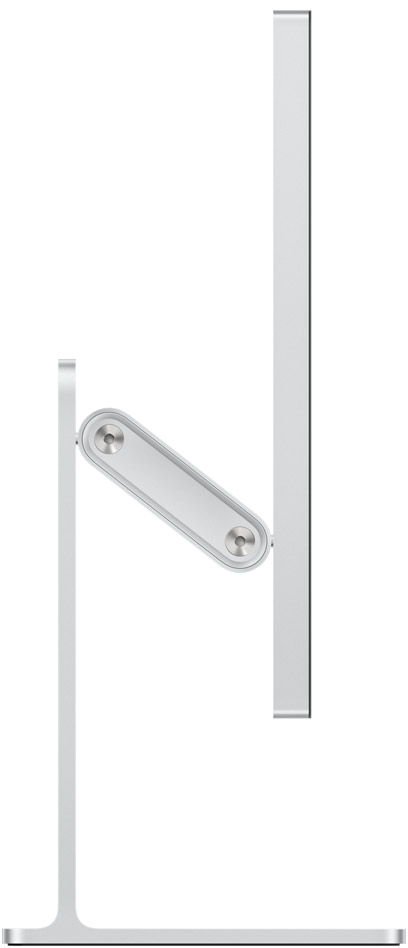
Jason’s primary complaint about the Studio Display isn’t its high price or how little it’s improved over the 2022 version. It’s that the base stand—the one you get for $1600—has no height adjustment. To get the ergonomic benefit of height adjustment, you need to buy either the VESA mount adapter (and an arm if you don’t already have one) or the exquisite height-adjustable stand, which is a $400 addition.
It’s hard to argue with Jason when he says this:
Apple claims it’s a champion of accessibility. But in my opinion, part of accessibility is ergonomics. Different people need displays at different heights, and we are all shaped differently. Apple’s continued insistence on shipping displays and iMacs that aren’t height-adjustable by default is frustrating. You spend all this money on a pricey Apple display and then, what, put it on an old dictionary? Meanwhile, even the cut-rate competition offers height adjustments.
The “old dictionary” comment reminded me that in the days of CRT monitors, I—and many of the people I worked with—used the CRC Handbook of Chemistry and Physics to bring our monitors up to the proper height. We all agreed it was the best use we’d ever gotten out of that book.
And that experience my friends and I had with the CRC Handbook points to an important fact about monitor height adjustment: for most people, it’s a set-it-and-forget-it feature. You get your monitor to a height that works well with your desk setup, and you don’t change it for ages. The smooth fingertip control Apple provides with its upgraded stand—while undoubtedly useful for some—isn’t the kind of ergonomic help that most customers need.
What Apple’s doing here is the opposite of what it does on the software side. Most Apple apps are built to be good enough for the great bulk of its users. People who need more—in a calendar, a mail client, a to-do manager, a spreadsheet, a word processor, and so on—go to third-party apps to get those extra features.
This has served both Apple and its customers well. Even those of us who consider ourselves power users aren’t power users across the whole gamut of computing. We use a mix of basic and advanced apps to match our needs. Apple doesn’t have to stay on the cutting edge of all its many software products, and we get free apps that handle a lot of what we do.
Maybe Apple thinks its basic stand has been designed to hit that sweet spot for the vast majority of its users. Maybe they’ve spent considerable time and money on studies of desks and chairs and torsos and have come up with a single monitor height that’s “just fine.” I hope not, because that money would’ve been better spent on a simpler and less beautiful height-adjustable stand.