
Scientific American and Friday the 13th
March 13, 2026 at 6:48 PM by Dr. Drang
Scientific American has a fun little article today about the frequency of Friday the 13ths. It ends with this table,
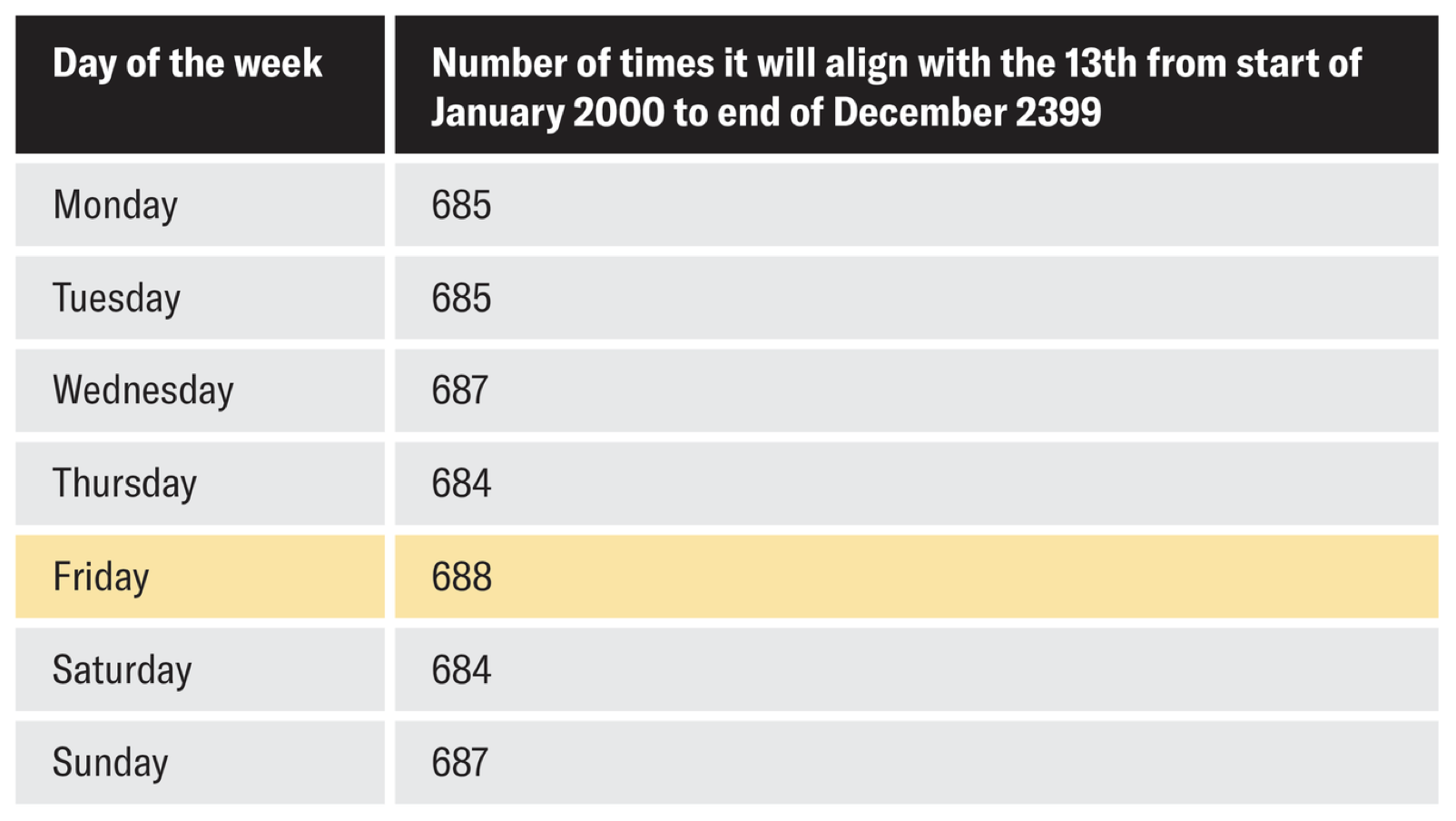
and this true but overstated conclusion:
In other words, the 13th of a month will be a Friday more times than any other day of the week.
Well, yes, if you live to be 400 years old, you’ll see one more Friday the 13th than Wednesday the 13ths or Sunday the 13ths. Kind of a weird thing to focus on, though. I’m guessing you’ll have other worries by then.
But I shouldn’t be so snarky. A few years ago, I wrote a post that calculated the same set of Fri13 counts for a 400-year Gregorian cycle. I did the calculations in Mathematica and (of course) showed the code. Today, I did the same thing in Python,
python:
 1:  #!/usr/bin/env python
 2:
 3:  from datetime import date
 4:
 5:  f13s = [0]*7
 6:  for y in range(1800, 2200):
 7:    for m in range(1, 13):
 8:      wd = date(y, m, 13).weekday()
 9:      f13s[wd] += 1
10:
11:  print(f13s)
and got a result of
[685, 685, 687, 684, 688, 684, 687]
for Monday through Sunday. This also matches the SciAm table.
Those of us who are alive now (and have realistic longevities) won’t live through any non-leap century years. For us, the calendar has and will repeat every 28 years (1461 weeks), and over every 28-year period in our lives, there will be 48 Fri13s, the same as the number of Mon13s, Tue13s, Wed13s, and so on.
Of course, few of us live exactly a multiple of 28 years. Personally, I’ve lived through 113 Fri13s so far, which is just under the number of Sun13s I’ve seen (114). So I’ve been lucky?
In a Friday the 13th post from way back in 2012, I talked about how Fri13s repeat within years because the number of days in certain month sequences is a multiple of 7. So if there’s a Fri13 in April, there will be another in July because
Apr + May + Jun
30  + 31  + 30  = 91
which is 13 weeks. The last time that happened was in 2018.
Similarly, if there’s a Fri13 in September, there will also be one in December because
Sep + Oct + Nov
30  + 31  + 30  = 91
That pair of Fri13s last happened in 2024.
There’s also an 8-month sequence that adds to a multiple of 7:
Mar + Apr + May + Jun + Jul + Aug + Sep + Oct
31  + 30  + 31  + 30  + 31  + 31  + 30  + 31  = 245
So there will be another Fri13 in November of this year.
The sequences above happen every year. In non-leap years only—this year, for example—a Fri13 in February will be followed by one in March. In leap years only, a Fri13 in January will be followed by one in April. That last happened in 2012.
I covered all these repeated Fri13s in that 2012 post. Today, I learned of a new repeat that spans certain year boundaries. If there’s a Fri13 in December of a non-leap year that’s followed by a leap year, there will be a Fri13 in March of that following year. That last happened in December of 2019 and March of 2020.
Superstitious or not, you have to admit March of 2020 was pretty unlucky.