
Simply supported beam—energy minimization with Fourier series
May 28, 2026 at 12:22 PM by Dr. Drang
Continuing our trip through various methods to derive the equation for the center deflection of a uniformly loaded simply supported beam, today we’re going to do the first of two solutions using the Rayleigh-Ritz method.
Of all the possible shapes a beam can deform into, the shape it will deform into is the one that minimizes the potential energy of the system, the system being the beam and the load. The equation for the potential energy for our beam, , is
where the first term comes from the bending of the beam (note its similarity to the formula for a spring) and the second term comes from the load acting through the deflection. The first term is positive because the potential energy of the beam increases as the beam bends; the second term is negative because the potential energy of the uniform load decreases as the load moves down with the beam.
Minimizing an expression like this with respect to the displacement function, y, is what the calculus of variations was invented to do. But Lord Rayleigh and Walther Ritz came up with a way to avoid the calculus of variations. Instead of considering all possible shapes for y, we can consider only certain shapes governed by a set of associated parameters. We then express the potential energy in terms of these parameters and solve for the parameter values that minimize it.
Let’s demonstrate with a simple example. We’ll assume y is of this form,
and find the value of a that minimizes
This sine function is a good choice because it meets all the boundary conditions of the simply supported beam: both it and its second derivative are zero at the two ends of the beam, i.e.,
(Recall that the moment is proportional to the second derivative of the displacement—since the moment is zero at a simply supported end, so is the second derivative.)
Given our choice for y, we can say that
Therefore,
The first integral works out to be and the second to . So
To find the value of a that minimizes this, we take its first derivative with respect to a and set it equal to zero:
which means
and
Compare this with our previous solution,
and we see that the one-term Rayleigh-Ritz approximation is awfully close to the exact solution.
But our goal wasn’t to get awfully close; it was to get the exact solution. To do that, we need to take not a single sine term, but the sum of an infinite number of sine terms, like this:
This is called a Fourier series, and you may recall seeing somewhere that a Fourier series can be fit to any function. In general, a Fourier series will have both sine and cosine terms, but for our problem the cosine terms drop out to meet the boundary conditions.
It may seem that we’ve just assigned ourselves an infinite amount of work, given that our expression for potential energy is now
But there are some features of the sine function that we can take advantage of. First and foremost, that nasty integral in the first term is actually quite simple:
And the second term can be simplified, too:
So we end up with
We minimize with respect to the by setting
for all m. Solving for we get
Plugging these results into our series expression for y and evaluating it at gives us
The sine term inside the sum alternates between 1 and –1, so we could write this as
At this point, I could get the sum from Mathematica with this expression,
Sum[(-1)^((m - 1)/2)/m^5, {m, 1, Infinity, 2}]
but that would be breaking my self-imposed rule against using computers in the derivation. Luckily, I have a book, An Introduction to the Elastic Stability of Structures by George Simitses, that discusses using infinite series in Rayleigh-Ritz solutions, and it includes this table of closed form solutions for infinite sums:
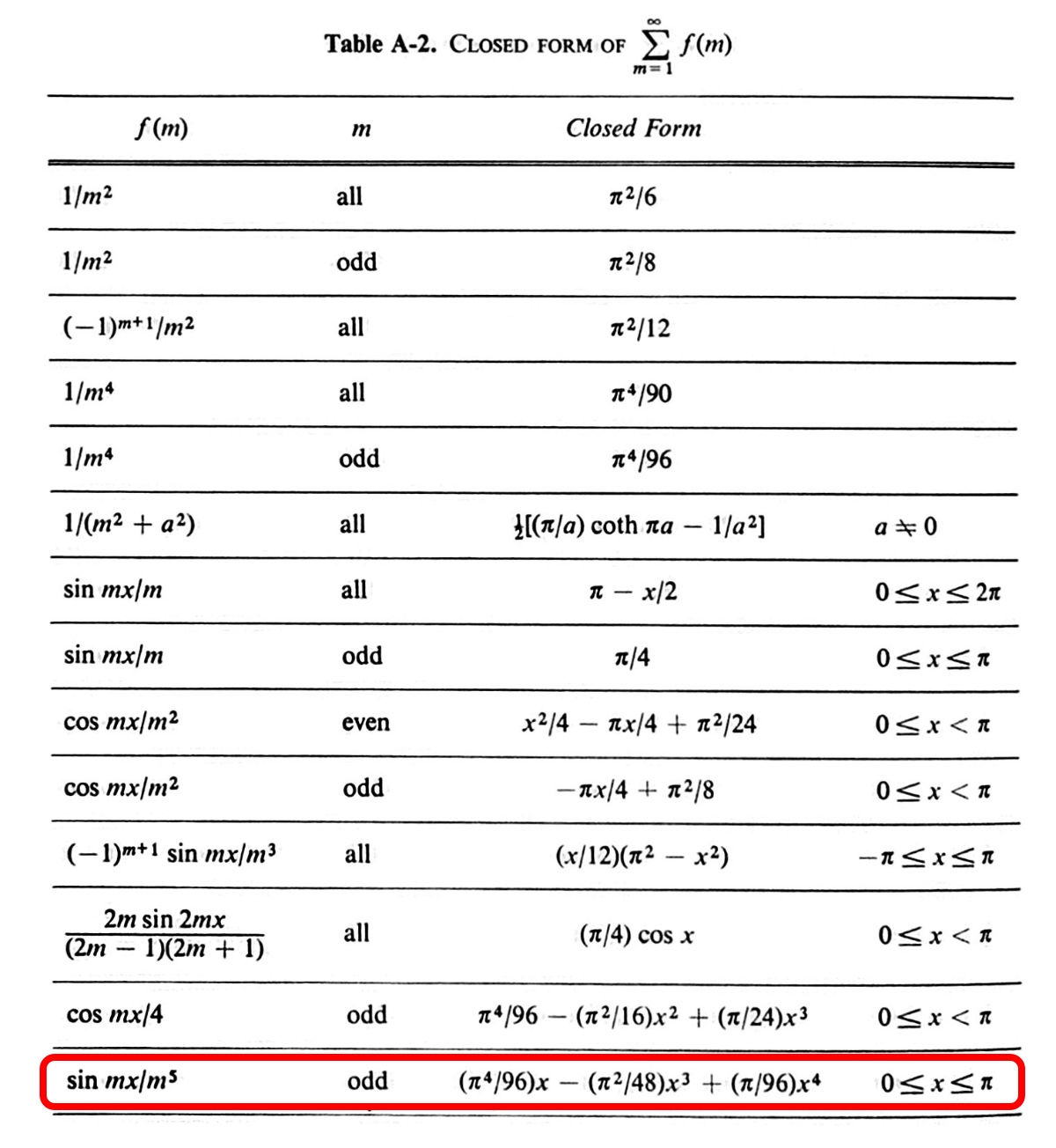
We can use the last entry in this table with to get
And through the magic of cancellation,
I’m not suggesting this is the best way to derive this formula, but it’s nice to know you can do it. And when you don’t need an exact answer, the Rayleigh-Ritz method can give you a good approximation without much work.