
Simply supported beam—the Myosotis method
May 26, 2026 at 8:28 AM by Dr. Drang
The sixth way we’ll derive the formula for the center deflection of a uniformly loaded simply supported beam is the Myosotis method, which I wrote about over a decade ago. This is the method popularized1 by J.P. Den Hartog in his Strength of Materials textbook.

Image from Wikipedia.
Myosotis is the genus of the forget-me-not flower, and the idea behind the Myosotis method is to memorize the following six equations for the tip angle and deflection of a cantilever beam under different loading conditions.
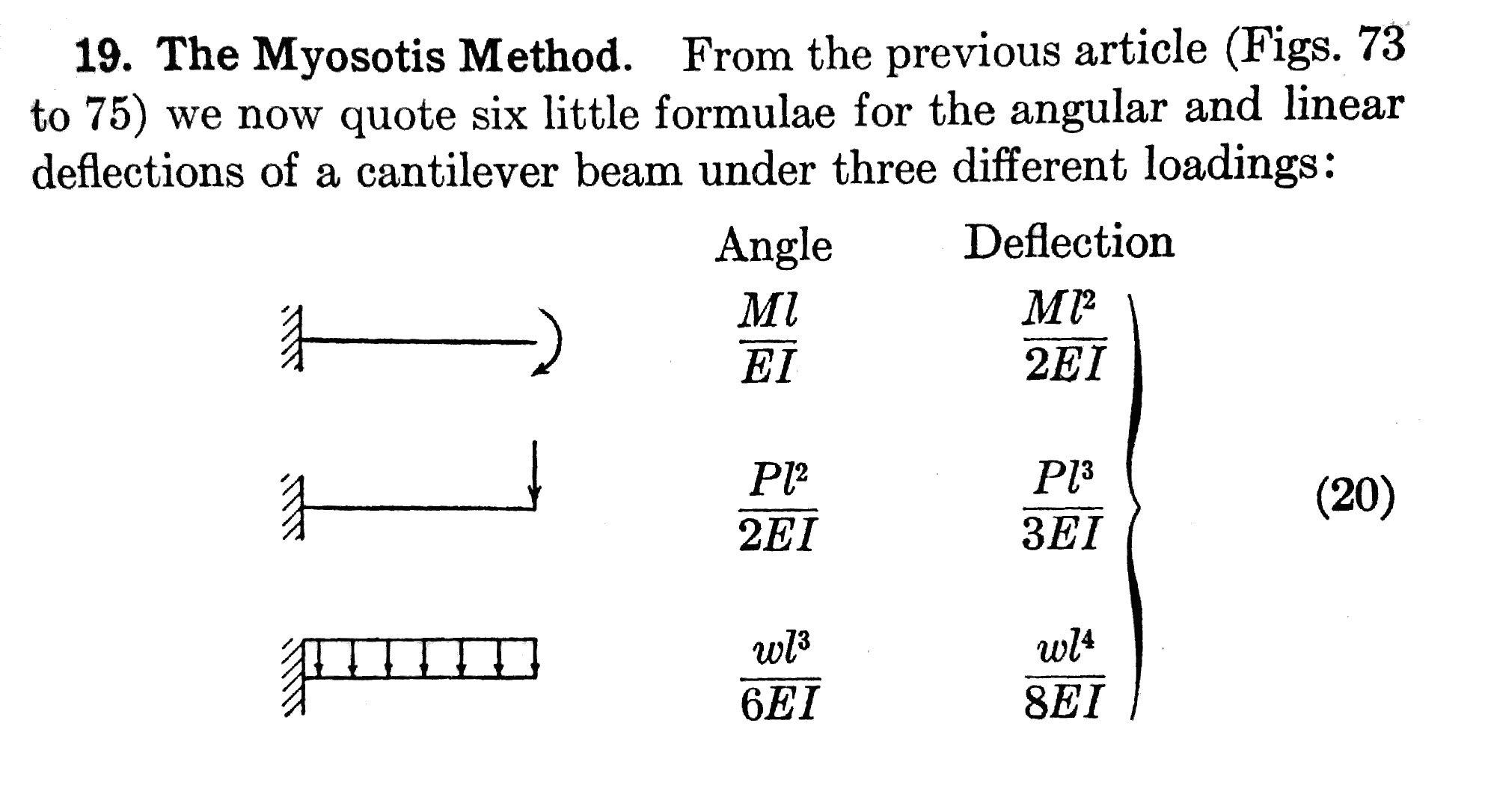
Once you have the formulas memorized, you can combine them to generate the solution for almost any beam that’s subjected to point and uniformly distributed loads. I wouldn’t say the Myosotis method is, or has ever been, a practical tool for working engineers, but it’s a great pedagogical tool for teaching engineering students how to take advantage of symmetry, antisymmetry, and superposition. Using it even a few times will get you thinking about how complex structural problems can be broken down into a combination of simpler solutions, and that will stay with you even if you never use the Myosotis method again.
We mentioned in the slope-deflection post that the left half of our simply supported beam behaves like a simple-guided beam. Let’s be more explicit about that. The symmetry of the problem we want to solve,
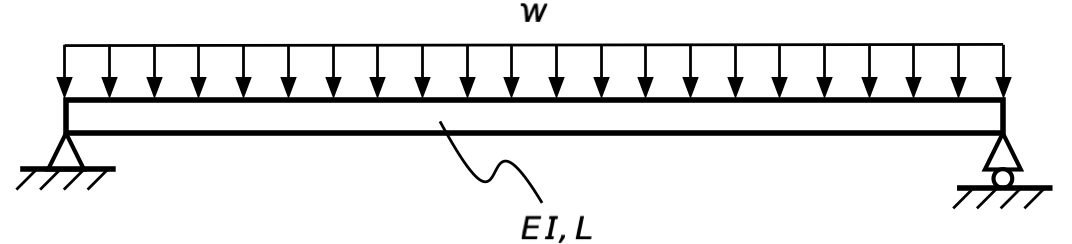
means it deflects like two simple-guided beams back to back:

This time, we’ll consider the right half:
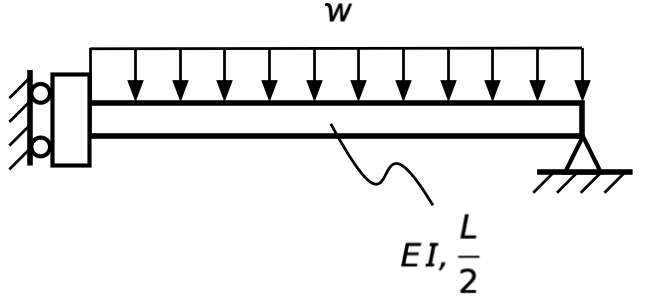
Statics tells us that the upward reaction at the right support is .
This is, apart from an overall downward displacement, the same as a fixed-free beam with both a uniform load over its length and an upward load at its tip:
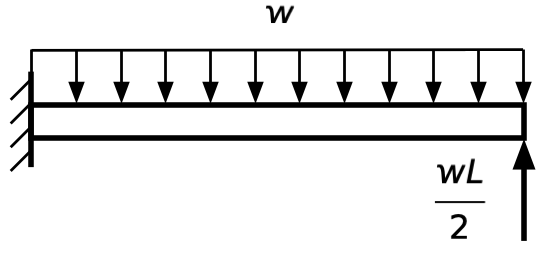
So the downward deflection at the center of our full-length simple-simple beam is equal to the left end deflection of our half-length guided-simple beam, which in turn is equal to the upward right end deflection of our half-length fixed-free beam. One of the purposes of a structural engineering education is to get you to see these relationships in a lot less time than it takes to type them out.
Now we can use superposition and two of the Myosotis formulas to get our answer. Here’s a graphical expression of how the superposition works:
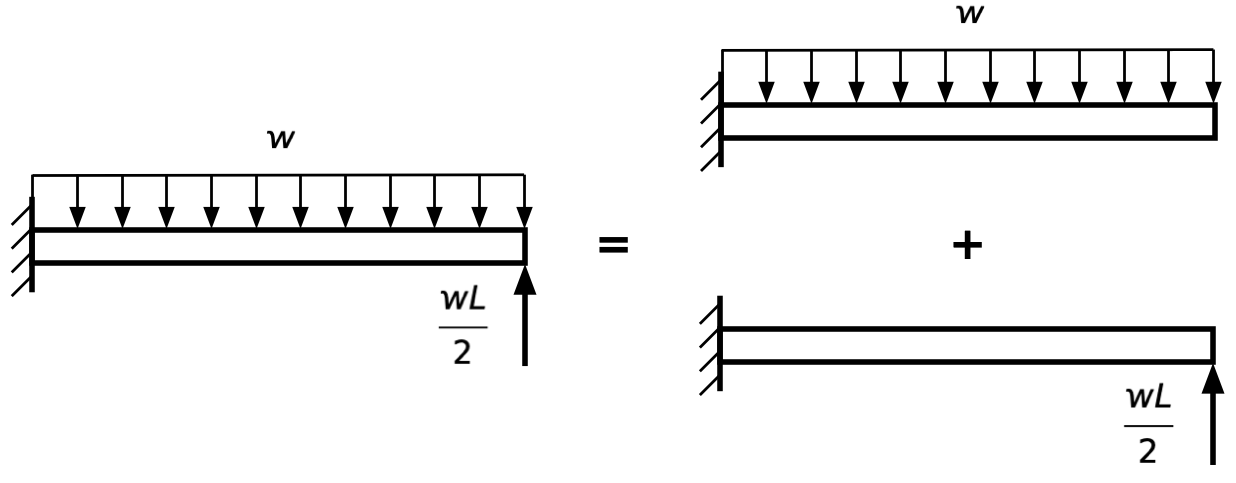
So the upward deflection of the right end of the fixed-free beam is
and that’s the same as the downward center deflection of our original problem, as expected.