
Areas of my expertise
May 18, 2026 at 12:25 PM by Dr. Drang
A few years ago, I wrote a post describing how I asked ChatGPT to solve a couple of elementary beam bending problems and how its answers were persistently wrong, even after I told it the mistakes it had made. For the first problem, determining the deflection at the center of a simply supported beam with a uniform load, ChatGPT gave the correct formula—presumably because the correct formula was part of its training corpus—but couldn’t come up with the correct numerical solution. As I said in the post:
Strictly speaking, this wasn’t a good example of a structural analysis homework problem. Students don’t get asked to just look up formulas and plug in numbers. More likely, they’d be asked to derive the equation that ChatGPT started with by either solving the differential equation for beam deflection or using some simplified technique like the moment-area or conjugate beam method. I didn’t think asking ChatGPT to do something like that would be fair.
This got me wondering how many ways I could derive the formula. A handful of ways came to me immediately, and I kept thinking of other methods over the course of the next several weeks.
Here’s a sketch of the problem:
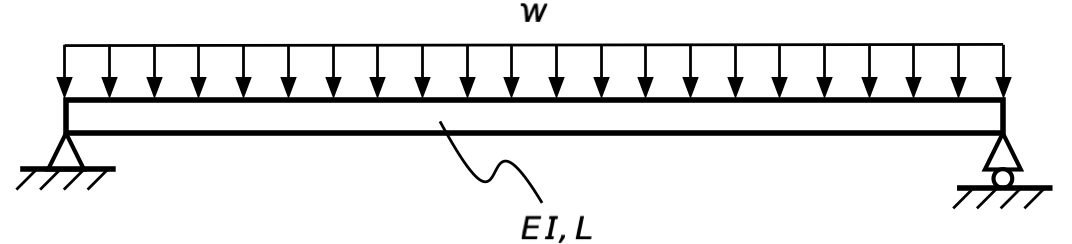
where w is the intensity of the load, in units of force per length, L is the length of the beam, E is the modulus of elasticity of the beam’s material, and I is the moment of inertia of the beam’s cross-section. I’m not going to get into the details of these terms or the assumptions implicit in my derivations. Suffice it to say that I’m using the typical definitions and assumptions described in strength of materials and structural analysis textbooks.
I gave myself some rules for the derivations:
- They had to be truly different methods; slight variations on the same technique didn’t count.
- They had to give an exact formula; no numerical approximations.
- They had to be arrived at by hand; no use of a computer. The upshot of this was that although methods that yielded simultaneous equations were OK, there could be no more than three simultaneous equations. No one in their right mind solves more than three simultaneous equations, and frankly, my skills have deteriorated to the point that more than two equations is iffy.
I scratched out the derivations in my notebook, eventually coming up with twelve ways. They were:
- Second-order differential equation
- Fourth-order differential equation
- The moment-area method
- The conjugate beam method
- The slope-deflection method
- The Myosotis method
- Energy minimization with Fourier series
- Energy minimization with polynomials
- Castigliano’s method
- Finite element analysis
- The dummy unit load method
- Newmark’s method
Update 6 Jun 2026 3:40 PM
Another method I thought of while writing the posts above:
Not sure why I didn’t think of this one earlier. Anyway, now we have a baker’s dozen.
I thought about presenting the derivations here, but I dithered over the best way to organize them. Eventually, other parts of my life intruded, and I gave up on the idea. It wasn’t until I wrote about the definition of “kip” a couple of weeks ago that I decided to just do a brain dump of all the derivations, one post for each. That’s what you’ll see here for the next couple of weeks. I know most of you don’t care about this sort of stuff, but I don’t care that you don’t care. Forewarned is forearmed—you’ll know what each post is about from their titles and can skip as you see fit.
For those few who are interested, this post will serve as a table of contents. The items in the list above will be turned into links as the posts are written.
Let me put a couple of things here that will be common. First, the deflection at the center is
This is the formula each post is aiming towards.
Second, the upward reaction forces at each end of the beam are
which is, as you might expect, half the total applied load.
Third, the shear and moment diagrams for the beam are
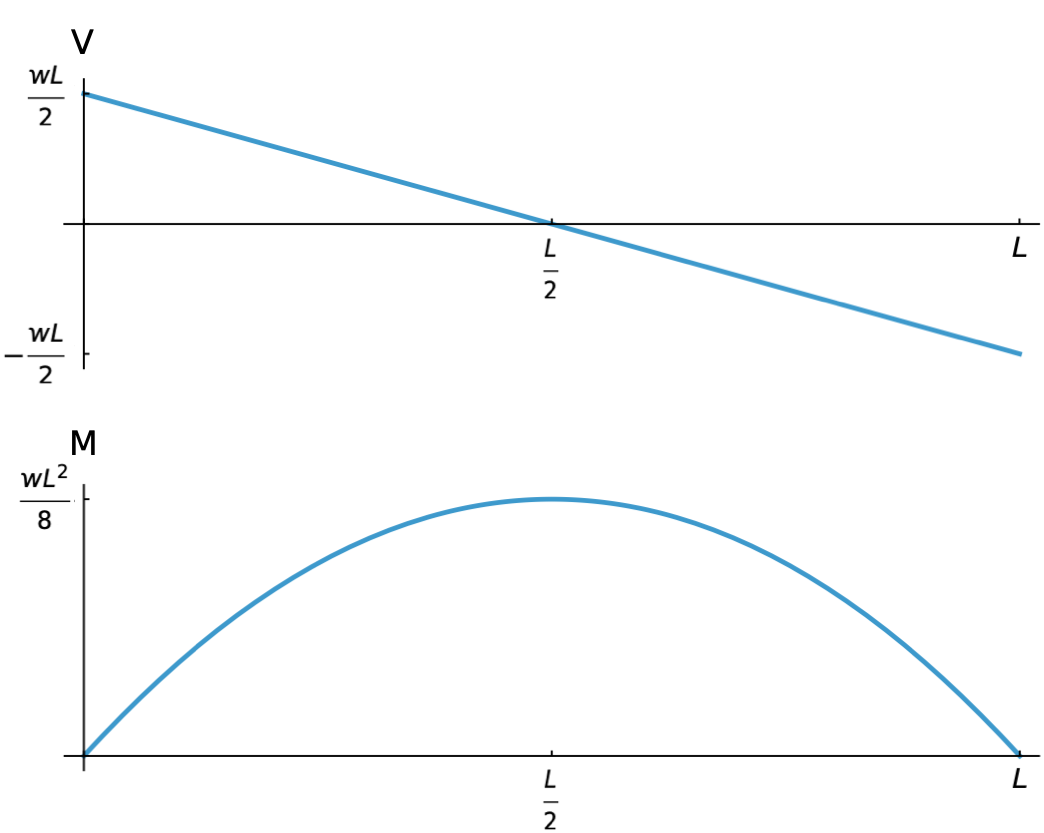
The moment diagram is very important to many of the derivations. It’s a parabola with a peak value of
We won’t be using the shear diagram1 directly in any of the derivations, but I tend to draw it whenever I draw a moment diagram. The mathematically inclined might notice that the shear is the derivative of the moment. It passes through zero when the moment is at its peak.
OK, that’s the setup. We’ll start zipping through the derivations next time.
-
Shear is usually denoted V because it’s a vertical force in most beams. ↩