
Krugman, Taylor, and Maclaurin
April 20, 2026 at 6:53 PM by Dr. Drang
In this morning’s blog/newsletter,1 Paul Krugman included a couple of unusual graphs that I want to talk about. It took me a little while—longer than it should have—to figure out what he was doing and why, and I’m still not sure I agree with his plotting choices. Let’s go through them and you can decide for yourselves.
The two graphs of interest are made the same way, so we’ll focus on the first one. He introduces it this way:
The closest parallel I know to the Hormuz crisis is the oil shock that followed the 1973 Yom Kippur War. (The 1979 Iran crisis was more complex, involving a lot of speculative price changes.) World oil supply fell only moderately after 1973, but it had been on a rapidly rising trend until then, so there was a large shortfall relative to that trend. In the chart below I show the natural log of world oil consumption with 1965 as the base year:
And here’s the graph itself:
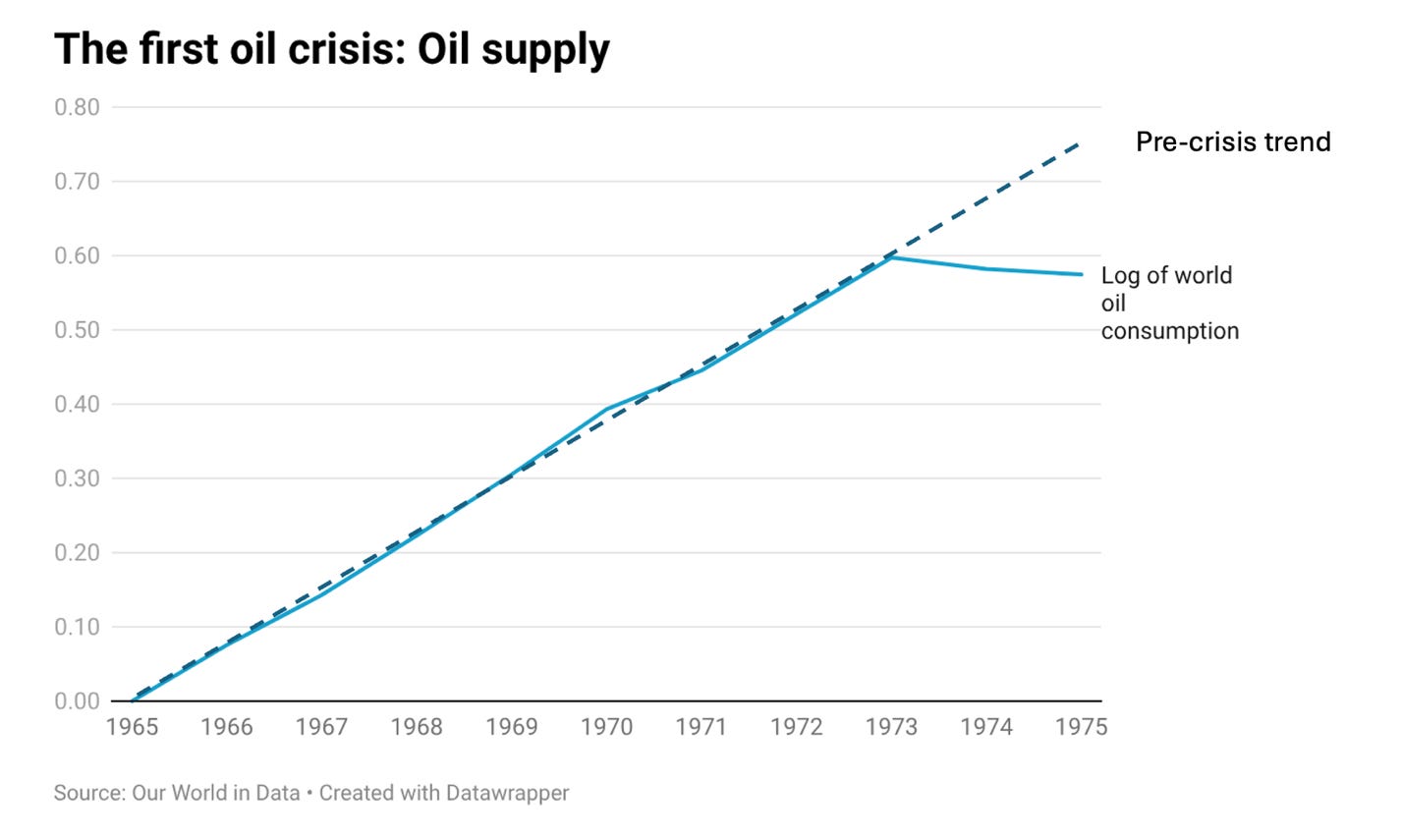
Krugman usually apologizes in advance for the “wonky” parts of his posts, so I was surprised that he just breezed through the “natural log” and “base year” parts of his explanation. What he’s doing here is taking the oil consumption of a given year, dividing it by the consumption in 1965 (that’s the “base year” part), and then plotting the natural logarithm of that ratio against the year. The ratio for 1965 itself is, of course, one, which is why its log is zero.
Using logarithms to plot exponential growth is common because you end up with a straight line. What isn’t common is plotting the logarithm (natural or common) of the values on a linear scale, as Krugman does here. Plotting software typically (always?) offers you the option of plotting the actual values on a logarithmic scale. The advantage of taking that option is that although the ticks will be unevenly spread, the tick labels will represent those actual values, not their hard-to-interpret logarithms.
The interior of the plot would look the same if Krugman had used a log scale for the vertical axis. We’d still see the straight line showing exponential growth from 1965 through 1973, and then the very slight decay after that. The only difference would be the spacing and labeling of the horizontal grid lines.
So why did Krugman make the plot the way he did? I guess the answer lies in the paragraph after the plot:
The percentage difference between two numbers is approximately the difference in their natural logs times 100. So this chart shows that the world was burning approximately 17.5 percent less oil in 1975 than it would have under the pre-1973 trend — a supply shock not too different from what we will see now if the Strait remains closed.
The first sentence of this paragraph is what took me a while to understand. Then I remembered a Taylor series—actually a specialized Taylor series called a Maclaurin series—that I haven’t seen in quite a while.
Consider exponential growth at a yearly rate of . After t years, the value, relative to starting value, will be
(Note that is expressed as a decimal value. If the yearly growth is , .)
Taking the natural log of both sides of this equation, and using the properties of logarithms and exponents, gives us
where
(I should mention here that because I’m an engineer instead of a mathematician or programmer, I use for the natural logarithm instead of . I use for common [base 10] logarithms.)
This means that is the slope of the exponential growth portion of Krugman’s plot.
This is where the series expansion comes into play. As I nearly forgot, we can express this logarithmic term as
and if is small, the higher-order terms are very small, and
so the growth rate (as a decimal) will be about equal to the slope of Krugman’s graph. To get the growth rate as a percentage, multiply by 100.
Is small? Yes. For the eight-year period from 1965 to 1973, we see that the natural log of oil consumption goes up about . So the slope of that portion of the graph is
which is pretty small.
The thing is, I’m pretty sure that whole “take the difference of the natural logs and multiply by 100” thing seemed like hand-waving to most of Krugman’s readers. If he’d just used a log scale on the vertical axis, he could’ve said that the lost oil consumption was about , and it wouldn’t have seemed so magical because we’d all be able to see it in the graph.
Unless his purpose was to entertain people like me. In that case, good job!
-
I’m pretty sure Krugman thinks of it as a newsletter because it’s hosted on Substack. I think of it as a blog because I read it through RSS. ↩