
Simply supported beam—slope-deflection equation
May 23, 2026 at 7:51 AM by Dr. Drang
The next technique we’ll use to derive the formula for the center deflection of a simply supported beam with a uniform load is the slope-deflection equation:
Let’s start by explaining where all the terms come from. Here’s a beam of length L with arbitrary end supports (could be simple, fixed, free, or sprung) and an arbitrary applied load. We’ll call the left end A and the right end B.
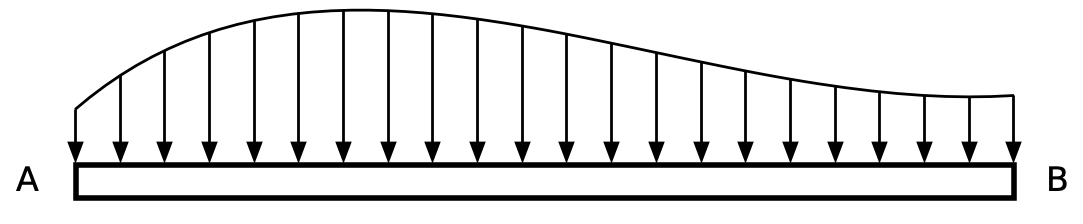
The moment at A is the sum of five terms, which come from the superposition1 of five conditions. First is the fixed-end moment (FEM), which is the moment that would exist at A if the beam had both ends fixed against vertical displacement and rotation:
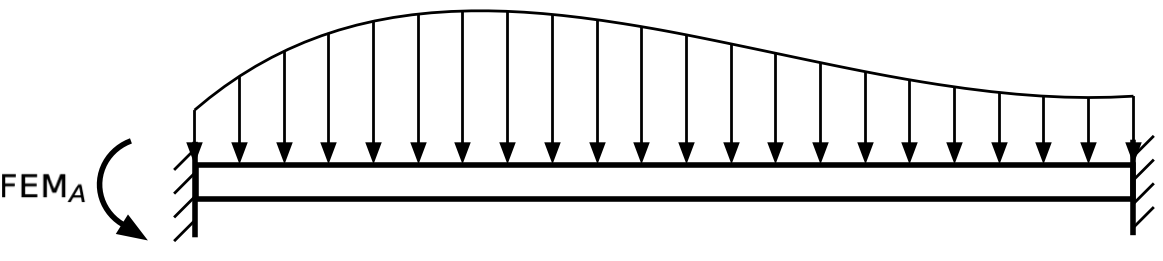
The other four terms come from analysis of the unloaded beam when specific geometric end conditions are applied. The end conditions are specified by the clockwise rotation at each end, , and and the downward defection at each end, and .
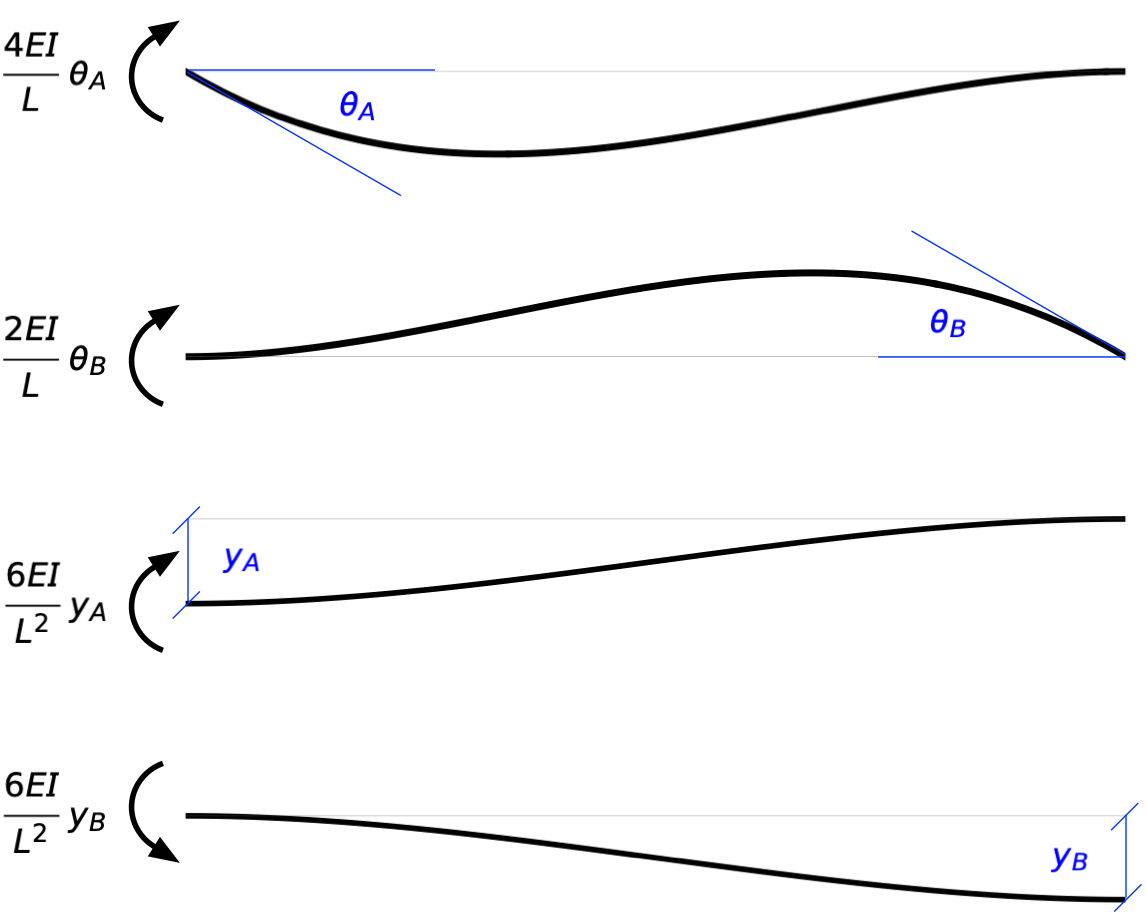
Each of these shapes comes from applying just one of these end conditions and keeping the others zero. The moment at A that corresponds to each of these shapes is given in the figure.
The general solution for the clockwise moment at A is the sum of these five terms:
Note that we’ve put in some negative signs to account for the counter-clockwise terms.
Let’s now define the span rotation as
This is the clockwise rotation of the straight line connecting points A and B.
Rewriting the third and fourth terms on the right-hand side of the equation using this definition, we get
Pulling out common terms gives us the equation at the top of the post:2
OK, let’s use this to solve our problem. We’ll start with our simply supported beam and label the two ends:
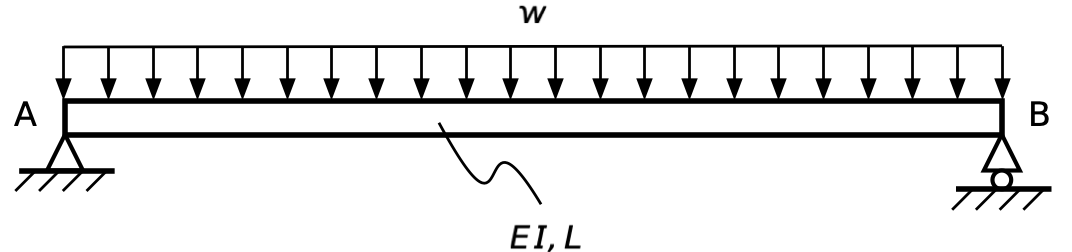
The simple supports mean and (the straight line connecting A and B stays horizontal through the deflection). Symmetry tells us . And the fixed-end moment for a uniform load is (this is another one of those things burned into my brain through repetition).
So
and therefore
which should look familiar.
To get the center deflection, we need to use symmetry in another way. It tells us that the slope at the center of the beam is zero, which means we can treat the left half of the beam as its own problem:
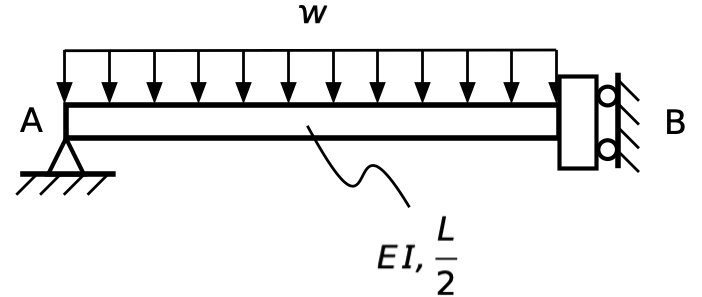
The right end of this half-length beam is guided, which means it’s free to deflect but prevented from rotating. This beam will behave exactly like the left half of our original beam.
For this half-length beam, we know that
where we’ve taken the expression for from the intermediate solution above. Plugging these into the slope-deflection equation gives us
And therefore, as we’ve seen five times now,
We had to solve two equations to get this result, but they weren’t simultaneous equations, so it wasn’t that much work.
-
There are other ways to explain the slope-deflection equation. I decided to explain it using superposition after getting this Mastodon reply from Chris Huck. ↩
-
Most texts define the FEM as positive in the clockwise direction, so it has a positive sign in the slope-deflection equation. Since the FEM at the left end of a beam under most loading conditions is counter-clockwise, I prefer to define it that way and use a negative sign in the equation. ↩