
Simply supported beam—conjugate beam method
May 22, 2026 at 8:01 AM by Dr. Drang
The fourth way we’re going to derive the formula for the center deflection of a simply supported beam with a uniform load is the conjugate beam method. This is probably tied with the moment-area method for the simplest and fastest way to get the formula—at least if you’ve memorized the properties of parabolas.
I wrote about the conjugate beam method last year. In a nutshell, it takes advantage of the similarity of the relationships between bending moment and distributed load,
and between displacement and bending moment,
To get the deflection of the beam, we construct a conjugate beam that’s loaded by the diagram of the real beam. Calculating the moment at a point of the conjugate beam gives us the deflection at the corresponding point in the real beam.
For our problem, the conjugate beam looks like this:
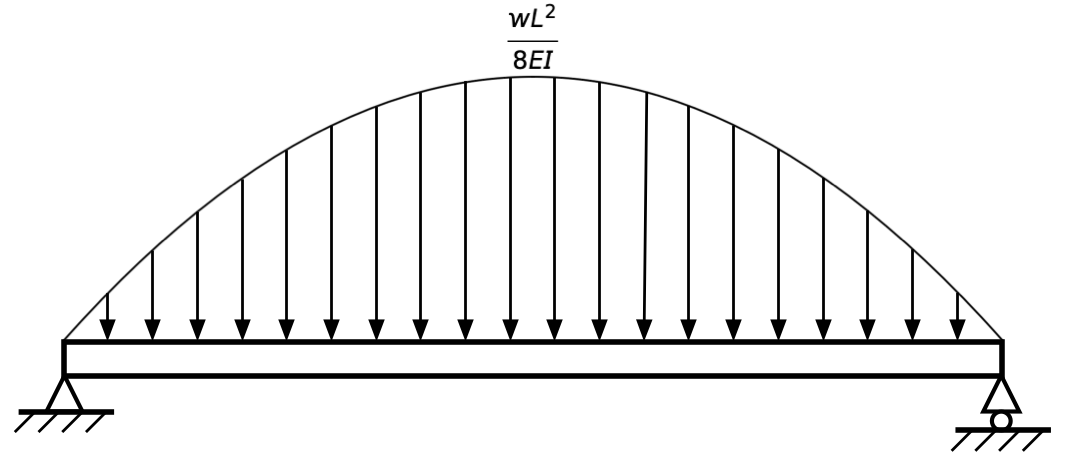
The supports of the conjugate beam don’t always match the supports for the real beam, but they do for simple supports, so that makes things easy. The intensity of the distributed load at the peak of the parabola is .
To get the bending moment at the center of the conjugate beam, we analyze a free-body diagram of its left half:
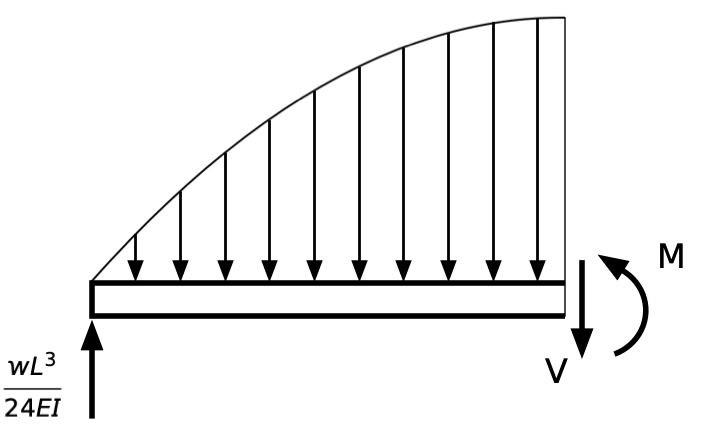
By symmetry, the reaction at the left support is (that’s the area under the parabola, and we’ve done that calculation before). That’s also the resultant of the distributed load. The line of action of the resultant is ⅜ of the way from the center to the left support. Therefore, the moment at the center of the conjugate beam is
so this is the center deflection of the real beam, as expected.