
Simply supported beam—moment-area method
May 21, 2026 at 8:22 AM by Dr. Drang
Continuing our odyssey through various ways of calculating the deflection at the center of a simply supported beam with a uniform load, today we use the moment-area method.
There are two moment-area theorems used to calculate the slopes and deflections of a beam. Here’s how they’re given in the textbook I used as an undergrad, the 3rd edition of Elementary Structural Analysis by Norris, Wilbur, and Utku.1
The first theorem is
The change in the slope of the tangents of the elastic curve between two points A and B is equal to the area under the diagram between these two points.
The second theorem is
The deflection of point B on the elastic curve from the tangent to this curve at point A is equal to the static moment about an axis through B of the area under the diagram between points A and B.
The “elastic curve” is the curve made by the beam in its deflected position. The “static moment” of an area is the product of that area and the distance from the area’s centroid to the given point. (It can also be expressed as an integral, as we’ll see in a minute). This sort of thing is easier to describe with examples than with words.
The first theorem should be pretty obvious, given that we already know that
so
The second theorem isn’t so obvious, but if we write it in terms of an integral,
you can get to the second moment-area theorem through integration by parts.
But we’re not here to derive the moment-area method—I did that last year—we’re here to use it. For our problem, let’s sketch the deflected shape of the beam and note that the slope at its center must be zero by symmetry.
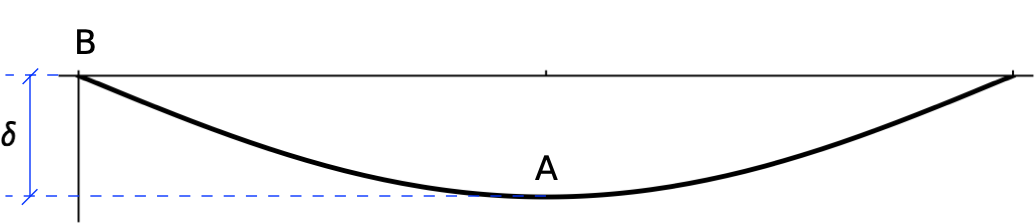
We’ll call the center A and the support at the left end B. The deflection at A is equal to the deflection of B relative to the horizontal tangent at A, which we’ll call .
By the second moment-area theorem, we take the moment diagram, divide it by EI, and multiply the area under the left half of the curve by the distance from B to the centroid of that area.
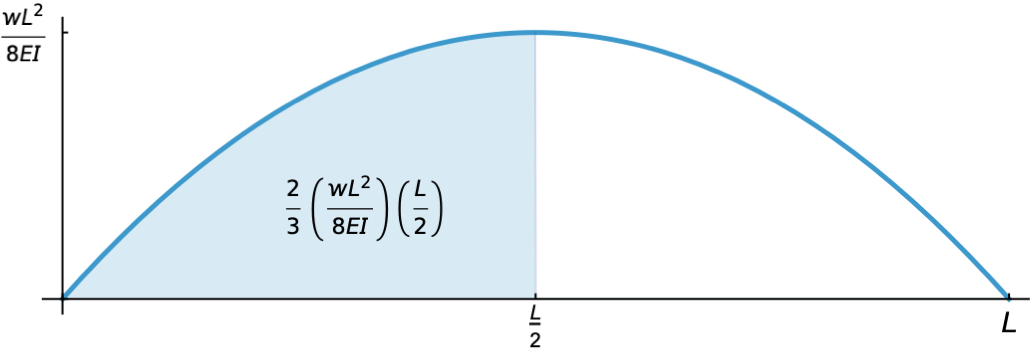
The area under the shaded part of the parabola is ⅔ of the area of the enclosing rectangle,
The distance from B to the centroid of the shaded area is ⅝ of the distance from B to A, so
which is the answer we were expecting.
How did I know the area under a parabola and the location of its centroid without looking it up? Lots and lots of practice doing problems like this 45 years ago. There’s a diagram with all the values in a post I wrote a few years ago.
One last thing: Because the slope at the center of the beam is zero, the slope at the left end should be equal to the shaded area calculated above. Click back to the previous article in this series, and you’ll see that it does match the value of calculated there.
-
Commonly known as “the MIT book” because that’s where the two senior authors taught. ↩