
Simply supported beam—fourth-order ODE
May 20, 2026 at 7:28 AM by Dr. Drang
In the introductory post to this series, I mentioned that the shear is the derivative of the moment. It’s easy to see that for our specific problem, the simply supported beam with a uniform distributed load,
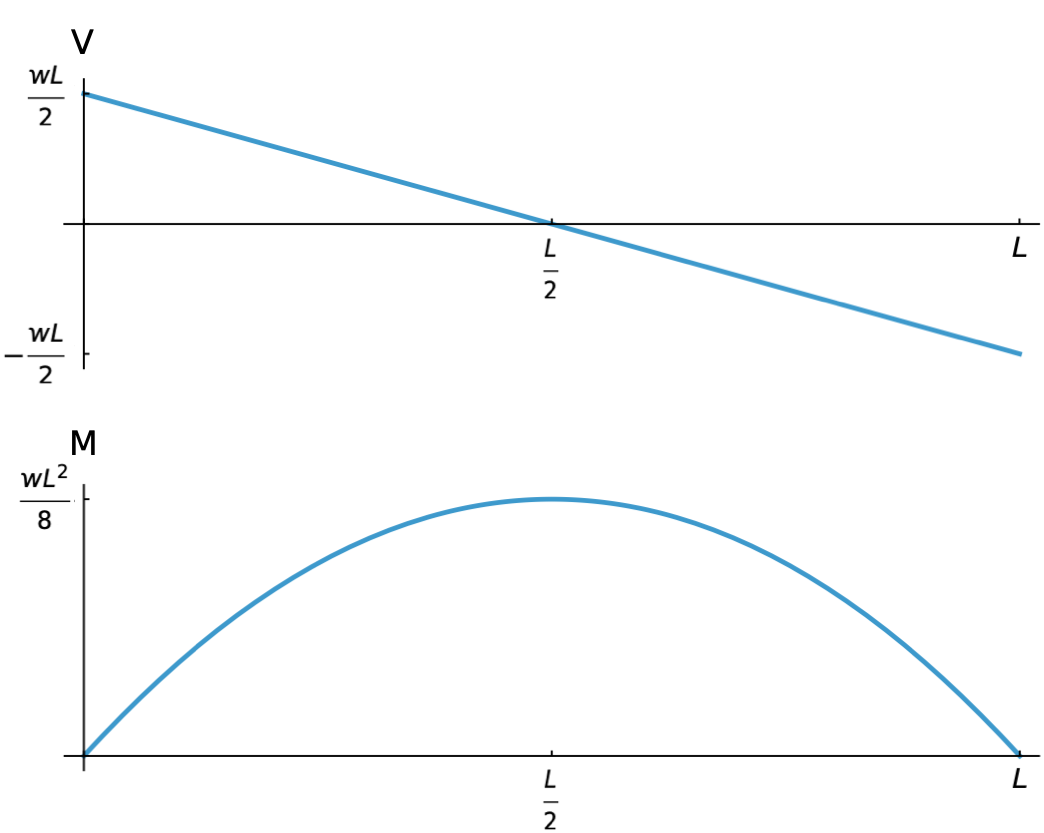
but it’s also true in general. A further relationship is that the distributed load function—let’s call it q—is the derivative of the shear (with a minus sign according to the usual sign convention). Therefore
which can be combined to give
Again, for our specific problem with a uniform load, is just the constant value , and it’s easy to see that the slope of the shear diagram is .
In yesterday’s post, we used the differential relationship between the moment and displacement,
and the fact that we already knew that the moment was a parabola to get a solution quickly. In general, though, people usually put the last two equations together to get
This is a non-homogeneous fourth-order linear differential equation with constant coefficients. The solution will have four constants of integration, which can be written in terms of the initial conditions, i.e., the displacement, slope, moment, and shear at :
(For small displacements, the slope and angle are the same, which is why the initial slope is called .)
The final term, , is the particular solution to the original equation, i.e., four integrations of q. Since q in our problem is just the constant w,
We know three of the initial conditions right off the bat:
Therefore,
We solve for the fourth initial condition by noting that the displacement at is zero:
Solving for gives us
Using this, the displacement at the center of the beam is
which is the formula we were looking for.