
Apple Park and Severance
July 21, 2026 at 6:24 PM by Dr. Drang
The indispensable Michael Tsai has an interesting post up today about Apple Park and whether its design isolates the people who work there, despite its having been designed—in part, at least—to encourage collaboration.
As usual, Michael has collected a group of choice quotes on the topic. I won’t link to any of them. You should just go to his blog, read the excerpts he’s assembled, and follow the links to see more. But I’ve often wondered how good Apple Park is as a working environment, especially when I watch Severance.
As you may know, the Lumon Industries building that Mark, Helly, Irving, and Dylan work in is a former Bell Labs facility in Holmdel, New Jersey. I first learned about the building several years ago, when I read Jon Gertner’s excellent history of The Labs, The Idea Factory. It’s a distinctive place designed by Eero Saarinen in the early 60s.
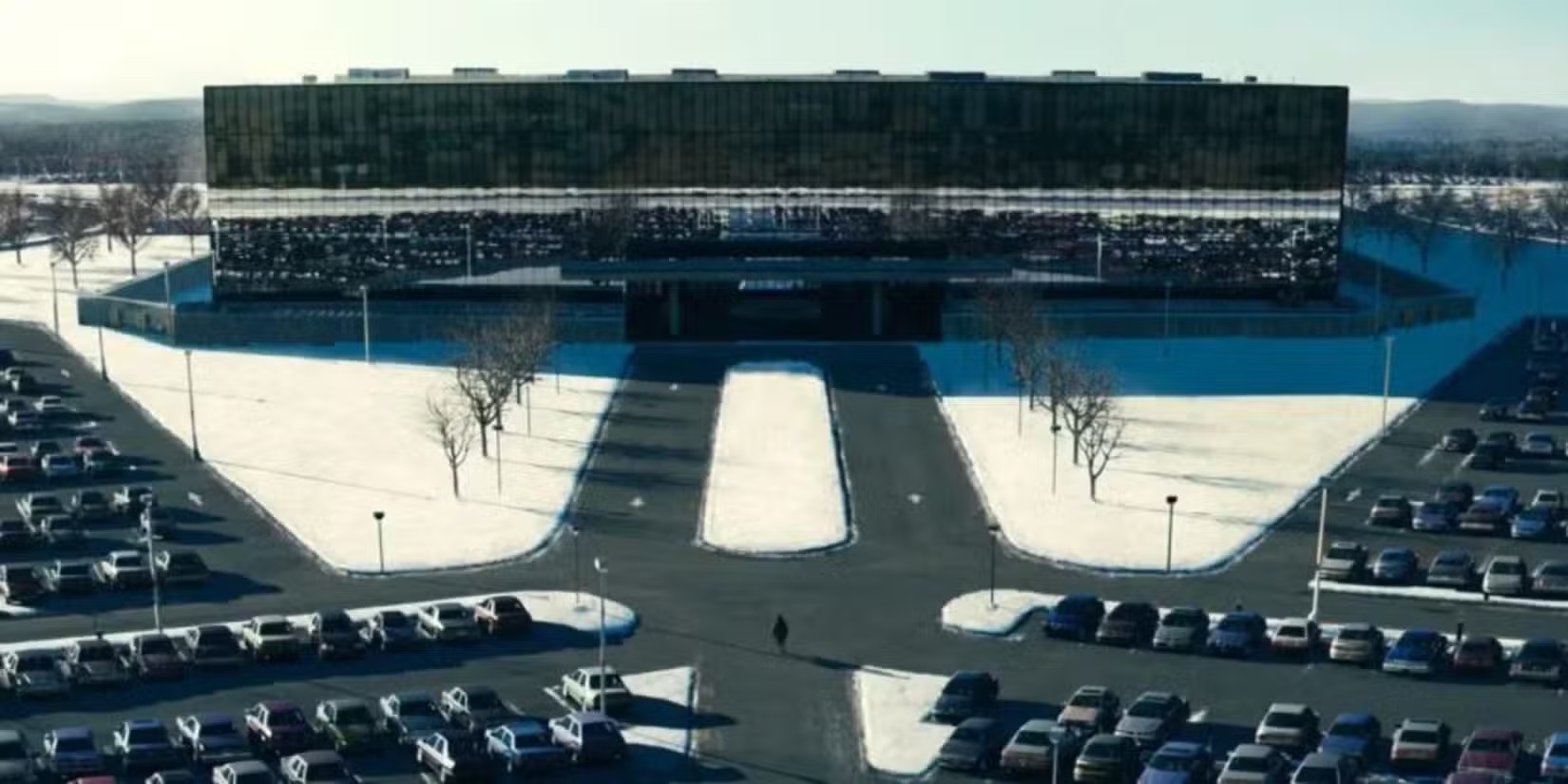
Image from GameRant.
Bell Labs was known for the fruitful collaboration of its researchers, often started through chance meetings in the hallways of other Bell Labs facilities. The new Holmdel building was supposed to further that sort of teamwork, but things didn’t work out as planned. Here’s Gertner:
The isolated Holmdel radio labs that had stood on the site for decades—the vast green fields where children would throw boomerangs on weekends, the gracious woodframe building around which engineers would test radio transmissions—were gone. Those labs had been razed. In their stead, on the center of 460 acres of former farmland, Bell Labs had commissioned an enormous modern building to accommodate its growing ranks.
I should mention here that those “vast green fields” and “isolated Holmdel radio labs” were where Karl Jansky invented radio astronomy. As for the building itself:
For obvious reasons, the building was soon nicknamed the Black Box. It was a steel-and-glass six-story structure, serious and austere, designed by the Finnish American architect Eero Saarinen. It was also a monument to architectural presumption. Saarinen, who died before his design was actually built, saw his creation as having the same kind of flexibility as Murray Hill— offices could easily be moved and partitioned, for instance—but with a crucial difference. He placed the building’s long connecting hallways on its glassy perimeter, with the windowless offices and labs in the interior. “Gone completely are the old claustrophobic, dreary, prison-like corridors,” Saarinen remarked with pride. Thanks to the floor-to-ceiling windows, the members of the technical staff would be liberated by unobstructed views of the countryside rather than chance encounters in the hallways.
I don’t want to hit you over the head with parallels, but does “floor-to-ceiling windows” remind you of any other place? Anyway, how well did the Holmdel building foster innovation?
[Labs employee Dick Frenkiel] soon came to realize that he had joined an organization that differed from its myth. The Black Box represented one aspect of this evolution. More to the point, the thrust of the work at Bell Labs seemed to have shifted decisively to big projects involving hundreds of people. Frenkiel’s Bell Labs didn’t seem to have anything to do with heroic research on a new amplifier, done by a few men in a hushed lab. It was about large teams attacking knotty problems for years on end.
I’m sorry, I said I didn’t want to hit you over the head with a̸ c̸a̸r̸ parallels, didn’t I?
Apple has lots of smart people. Some of them must know that the dystopian center of its hit TV show is the 1960s version of Apple Park.