
Floating Saturn calculations
July 16, 2026 at 9:14 PM by Dr. Drang
You’ve probably seen somewhere that the density of Saturn is less than that of water. If there were a bathtub big enough to hold it, Saturn would float. I think I first read this in one of Isaac Asimov’s collections of science essays. If you do an image search, you can easily find many illustrations of Saturn floating in water. Most of these show no more than half of Saturn under the water. Could that be right?
Because there were several things I should have been doing this afternoon, I decided to work out how much of Saturn should be underwater in these images. Even better, I’d do the more general problem: how much of any sphere would be submerged in a liquid if the density of the sphere is less than that of the liquid?
Here’s a cross-section of the problem:
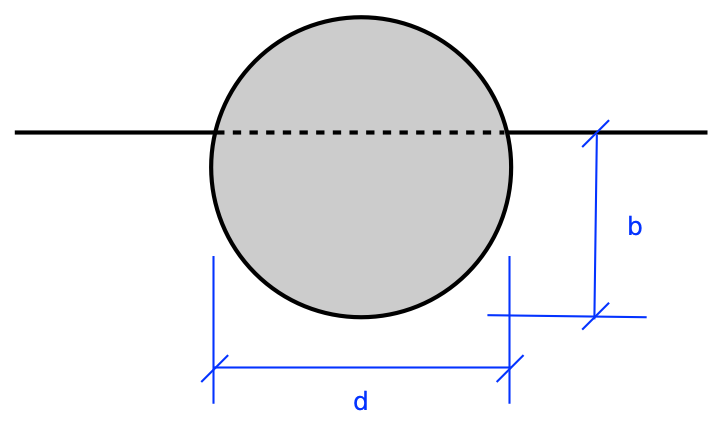
We’ll say the sphere has a radius , a diameter , and a uniform density of . The density of the liquid is . Because the sphere floats, . The distance is how far the bottom of the sphere is below the liquid surface.
The mechanics of the system is simple: the mass of liquid displaced by the submerged portion of the sphere is equal to the entire mass of the sphere. That is,
where
is the volume of the submerged portion of the sphere and
is the volume of the entire sphere. These expressions are usually given in terms of , as I’ve shown here, but eventually I want to work out the value of as a fraction of .
In fact, since I want to make a plot, which requires pure numbers, let’s nondimensionalize our variables by saying
Putting all this together and doing a little algebra, we get
Since neither nor is zero, the expression in the parentheses must be. In other words,
Since , the right-hand side of the equation must be greater than zero, so we don’t have to worry about negative densities.
Typically, we’d want to calculate for a given value of , so this equation isn’t in the most useful form. But it’s easy to plot values using this equation, even if we do want to be plotted on the horizontal axis.
I mentioned earlier that I prefer to show the depth as a fraction of the diameter, not the radius, i.e.,
Here’s that plot, which comes out in a sigmoidal shape:
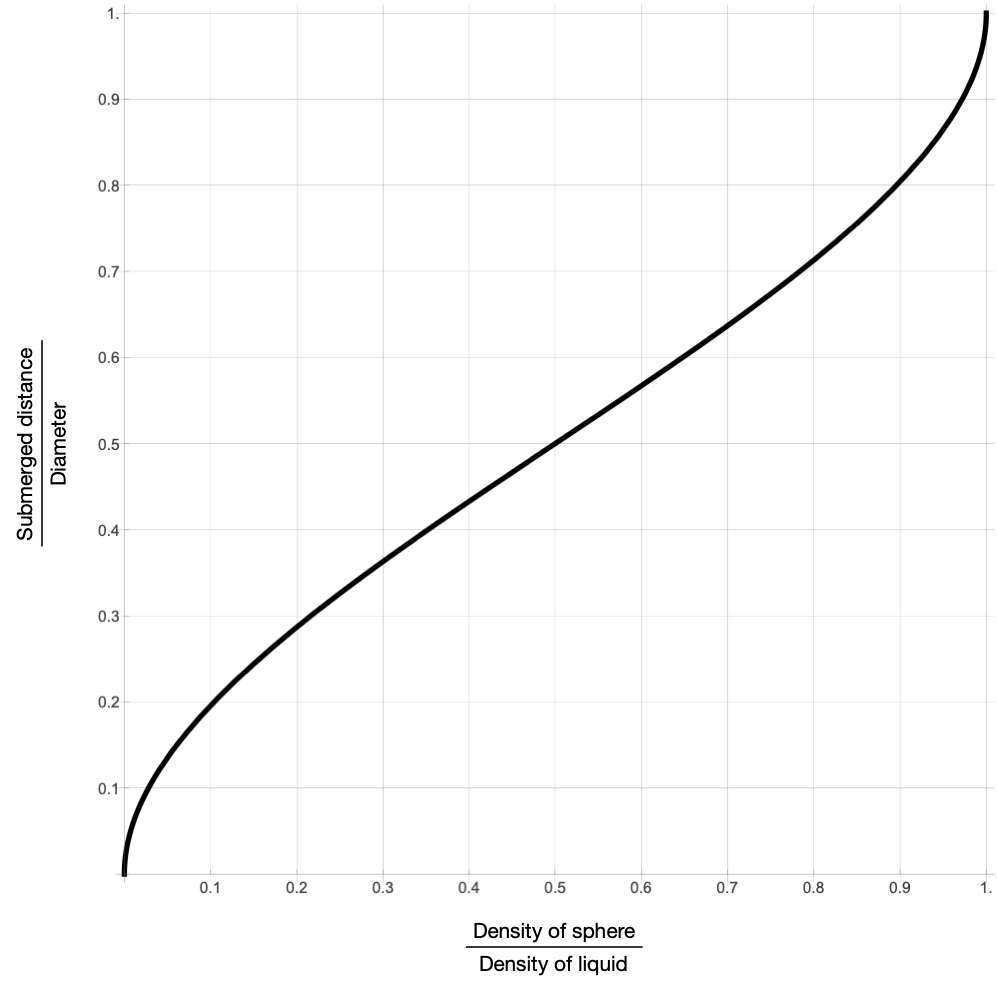
To figure out how much of Saturn would be under the water, we need Saturn’s density, which we can find on NASA’s old Saturn Fact Sheet, as archived on the Wayback Machine. It’s , which means our density ratio is 0.687. Looking that up in the plot, we see that the submerged portion of Saturn is between 60% and 65% of its diameter. A quick numerical solution gives us 62.7% of the diameter. Only 37.3% would be high and dry.
So those many illustrations showing more than half of Saturn’s diameter sticking out above the water are all wet.1 Of course, just seeing that Saturn’s specific gravity was over 0.5 is enough to know that most of it is underwater, but now we can put a number on it.
-
Yes, I went there. ↩