
Simply supported beam—energy minimization with a polynomial
May 30, 2026 at 2:09 PM by Dr. Drang
Today we’ll use the Rayleigh-Ritz method again, but this time we’ll avoid dealing with an infinite sum. In case you’ve forgotten, this is our problem:
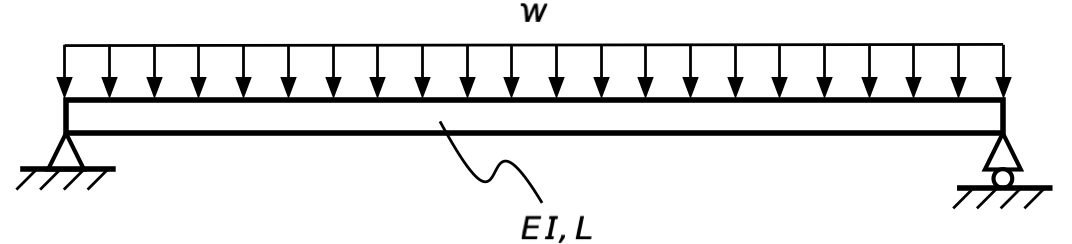
We’ll express the shape as a polynomial. The form of the governing differential equation,
tells us that our solution won’t have any terms of higher power than . That gets rid of the infinity problem, but a generic fourth-order polynomial still has five parameters,
which is more than we want to deal with. Let’s cut down further on the number of parameters by taking advantage of some other things we know. First, the solution will have to be symmetric, so we can express it with symmetric terms right from the start. Second, we know the solution will have to meet these boundary conditions:
Here’s the form we’ll start with:
This is a fourth-order polynomial. We know it’s symmetric about the center of the beam because switching the and terms (which is like flipping the beam around) yields the same equation. And it’s clear that , so we meet two of the four boundary conditions. Now we’ll take on the other two boundary conditions.
We’ll use the product rule and a little algebraic rearranging to give us the first derivative with respect to x:
The second derivative is
Since ,
which means
and therefore, after some more algebraic cancellation and rearranging,
and
Because we started with a symmetric function, its second derivative is also symmetric and .
Now it’s time for Rayleigh-Ritz. Recall that the potential energy, , is
Plugging in our expressions for and gives us
where the first term is the potential energy of the bent beam and the second two terms are the potential energy of the load as it moves down with the beam.
The integrals are fairly easy to work out. Just expand the polynomials and integrate term-by-term. Here are the results:
and
Therefore,
We minimize this by taking the derivative with respect to a, setting it to zero, and solving for a. That gives us
which we’ve seen as an intermediate solution before.
Finally, after plugging in this expression for a, we get
Our old friend comes to visit again.