
Simply supported beam—Castigliano's method
June 1, 2026 at 8:06 AM by Dr. Drang
Continuing our series on the many ways to get the center deflection of a uniformly loaded beam, we come to another energy-based technique: Castigliano’s method.
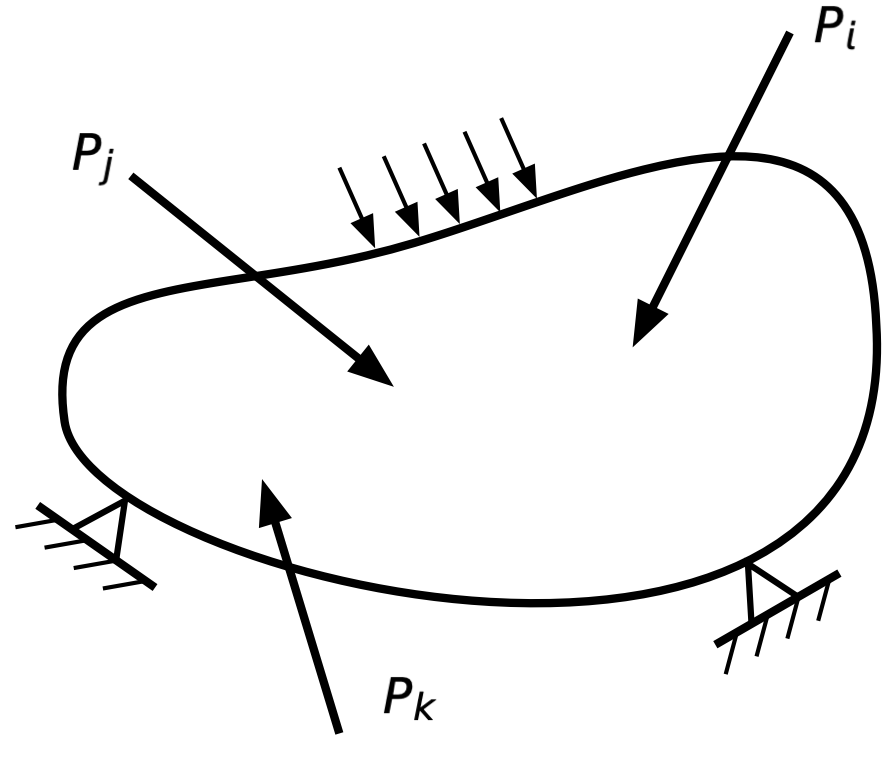
Castigliano’s second theorem provides a relationship between displacements, forces, and the strain energy in a linearly elastic system. The strain energy, U, is the potential energy of the system due to its deformation. For a generic elastic body, like this,
Castigliano’s second theorem can be as:
If an elastic system is mounted so that rigid-body displacements of the entire system are impossible and certain external point forces , , … act on the system, in addition to distributed loads and thermal strains, the displacement component of the point of application of force in the direction of force is determined by the equation
I took this from Henry Langhaar’s Energy Methods in Applied Mechanics, a favorite text of mine. I’ve altered the variable names to avoid conflicting with some variable names we’ve used in previous posts in this series.
Looking this over and thinking about it in terms of our problem,
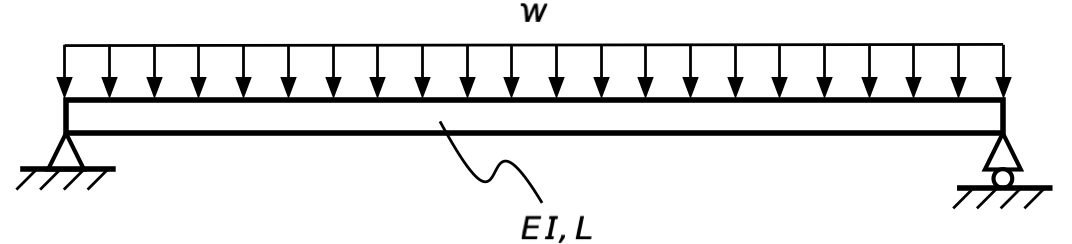
two concerns come to mind:
- Our problem doesn’t have a point force at the center of the beam, where we want to determine the deflection.
- Even if we did have a point force at the center of the beam, how do we write an expression for the strain energy in terms of that force?
Let’s tackle the second concern first. Recall from our two Rayleigh-Ritz posts (Fourier and polynomial) that the potential energy associated with beam bending is
This is the strain energy, U. Unfortunately, it’s written in terms of deflection, not force, but we can fix that. We saw early on that the curvature, , and the bending moment, M, are proportional:
We substitute the second of these into the expression for U to get
Because the bending moment can be written in terms of the applied loads, we’ve solved the second concern.
We solve the first concern with a trick. We can pretend there’s a load, P, at the center of the beam, and write out an expression for the bending moment, M, that includes P.
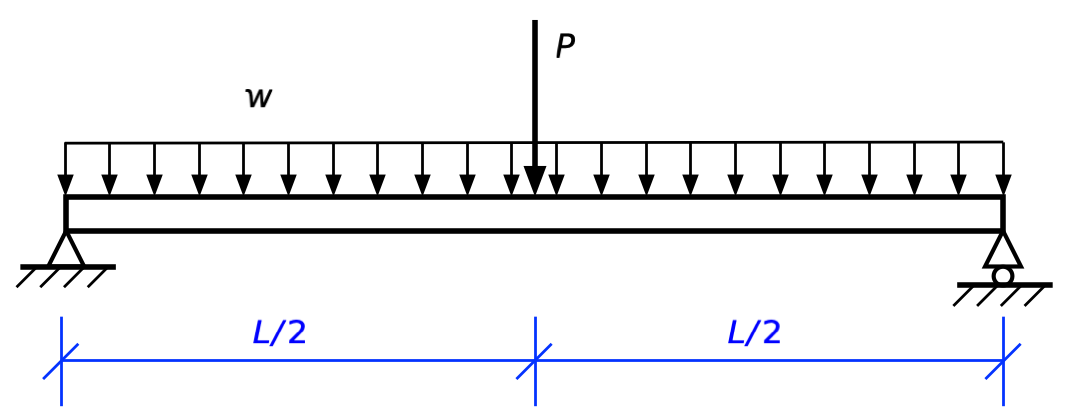
We then do the integration to get U, take its derivative with respect to P, and—here’s the trick—evaluate the derivative for . This may seem like cheating, but it’s perfectly legitimate. Imagine P is very very small—it won’t contribute much to the deflection. So why not just make it zero?
Let’s go ahead and see what happens. The upward support reaction force at end of the beam above is , so we can draw a free-body diagram for the left portion of the beam like this:
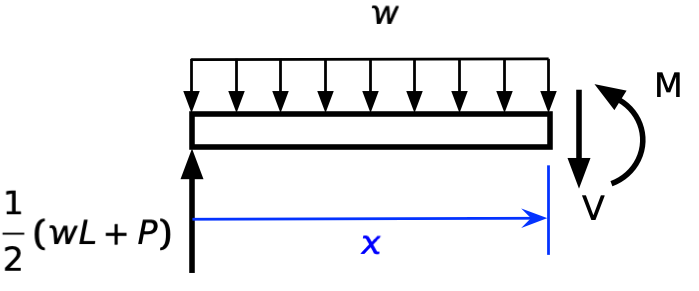
where . The bending moment in the left half of the beam is therefore
and its square is
This formula applies only in the left half of the beam, but because of symmetry we know that
So
Taking the derivative with respect to P gives us
Therefore the downward deflection at the center of the beam is
as we’ve now seen many times.
Since this is based on Castigliano’s second theorem, you may be wondering what kinds of problems we use his first theorem to solve. It’s a good question, but one I can’t answer. In the 45 years since I first learned of Castigliano’s theorems, I’ve never used his first one.