
Simply supported beam—finite element method
June 3, 2026 at 8:24 AM by Dr. Drang
The biggest problem I face when writing posts in this series is deciding how much background explanation to put in. If I included only the stuff I do to get the answer, the posts would be very terse: one sketch and a dozen or fewer lines of math. A full explanation, though, could easily turn into several semesters’ worth of structural analysis theory. I’m trying to get close to the former while adding just enough background so readers with engineering experience can follow along. Even if you haven’t used the method of a particular post, you should be able to take what’s in the post and find the whatever further information you need to fill in the inevitable gaps.
This problem is most acute in describing today’s analysis. The finite element method—more precisely called matrix structural analysis or the direct stiffness method when applied to structures made of beam, truss, or frame elements—has many analytical parents: the Rayleigh-Ritz method, the slope-deflection equation, and matrix math. Presenting it without at least some of its antecedents would be a crime. But I will try to keep the introductory material to a minimum.
The fundamental piece of this analysis is the beam bending element. This is a length of beam with no interior loading, and its behavior can be described completely by four parameters, called its degrees of freedom. The DOF are the the displacements and rotations at the two ends (or nodes) of the element, usually numbered and directed as follows:
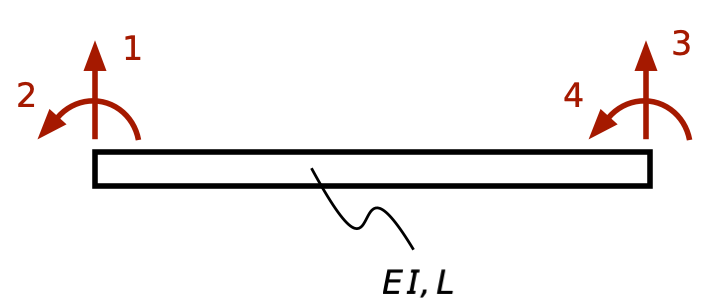
The DOF are often called generalized displacements, and we’ll refer to them as , , , and . The deflected shape of this beam is completely determined by the sum of the products of these generalized displacements and a set of shape functions that look like this:
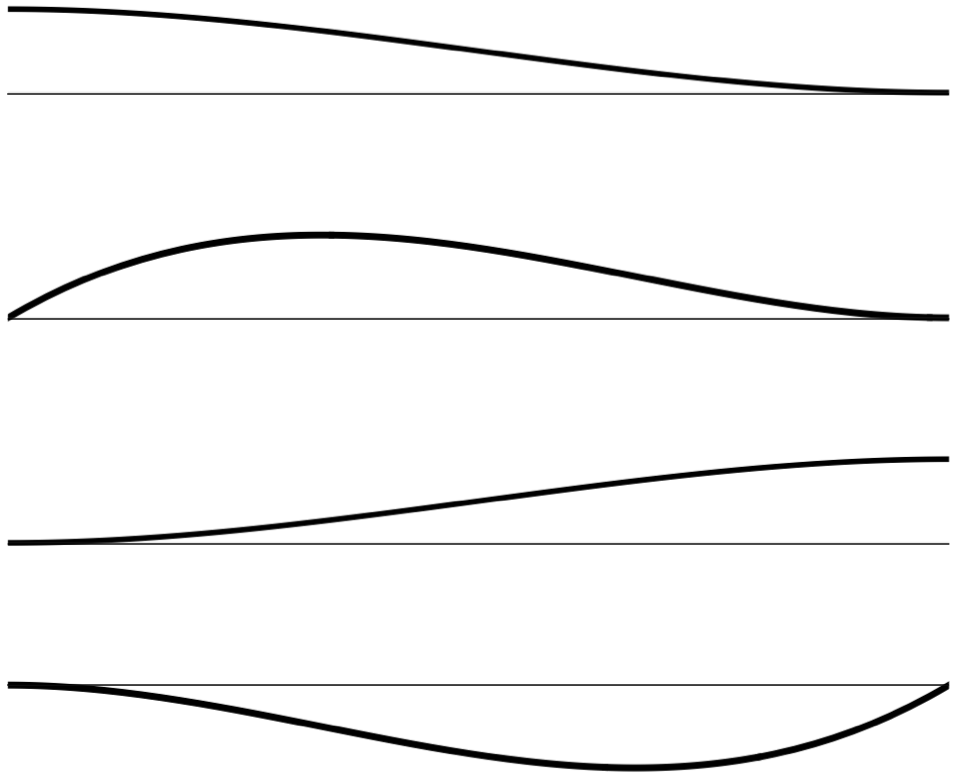
Each shape function is a cubic curve that has a unit displacement corresponding to one of the DOFs and zero displacement corresponding to the other three DOFs. Apart from the sign convention, these are the same shapes we saw in our discussion of the slope-deflection equation.
There is a generalized force associated with each DOF; these are the forces and moments at the two ends of the beam, and we’ll call them , , , and . Note that when we multiply a u term by an f term, we get an energy expression. For DOF 1 and 3, that’s a displacement multiplied by a force; for DOF 2 and 4, that’s a rotation multiplied by a moment.
For this element, we can write a matrix equation for the relationship between the generalized displacements and generalized forces,
where
and
Each column is the set of generalized forces that correspond to that shape function.
You may notice that the terms in the second row of match the coefficients in the slope-deflection equation before the and terms were combined into the span rotation term.
What should we do when, as in our case of a beam with a distributed load, there is interior loading? We convert that internal loading into what are called consistent loads at the ends. These are equal in magnitude and opposite in direction to the reaction forces and moments that would occur if the interior loads were applied to a beam with both ends fixed: for DOF 1 and 3 and for DOF 2 and 4.
To solve a problem by the finite element method, we assemble the structural stiffness matrix, , and the structural force vector, from all the individual elements and then solve the structural equation,
for the vector of structural displacements, . As you can see, I tend to use lower-case letters for the element terms and upper-case for the structural terms. That’s a reasonably common, but by no means universal, notation.
In general, this assembly and solution of a matrix equation can be quite complex, which is why the finite element method is typically thought of as a process that requires a computer. But our problem is simple enough to do by hand.
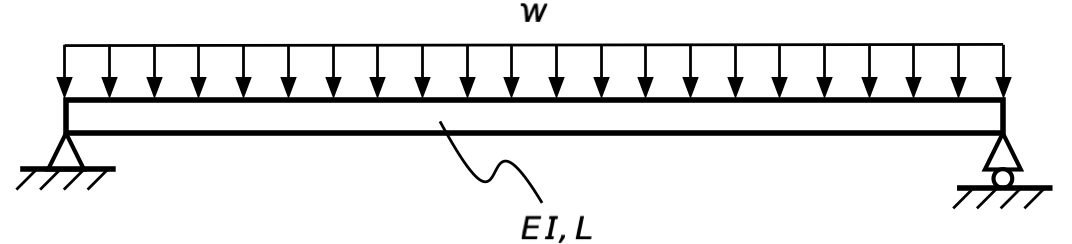
Recall that in both the slope-defection and Myosotis solutions, we took advantage of symmetry and considered just half the beam. We’ll do that again here.
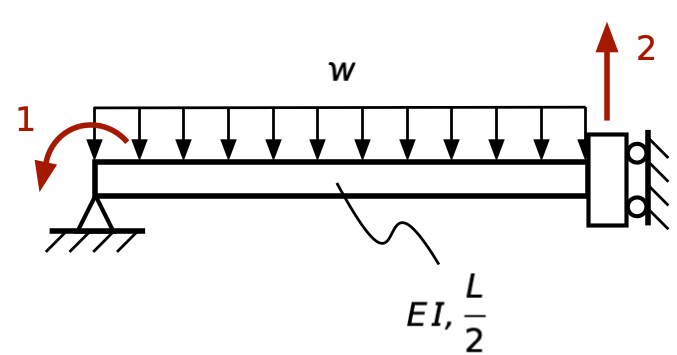
This half-beam has just two DOF, the rotation at the left end and the deflection at the right end. In the assembly process, element DOF 2 matches structural DOF 1 and element DOF 3 matches structural DOF 2. The other element DOF don’t appear in the structural matrix equation because their U terms are zero. Here’s an illustration of the assembly process for the stiffness matrix, accounting for the fact that the beam element has a length of :
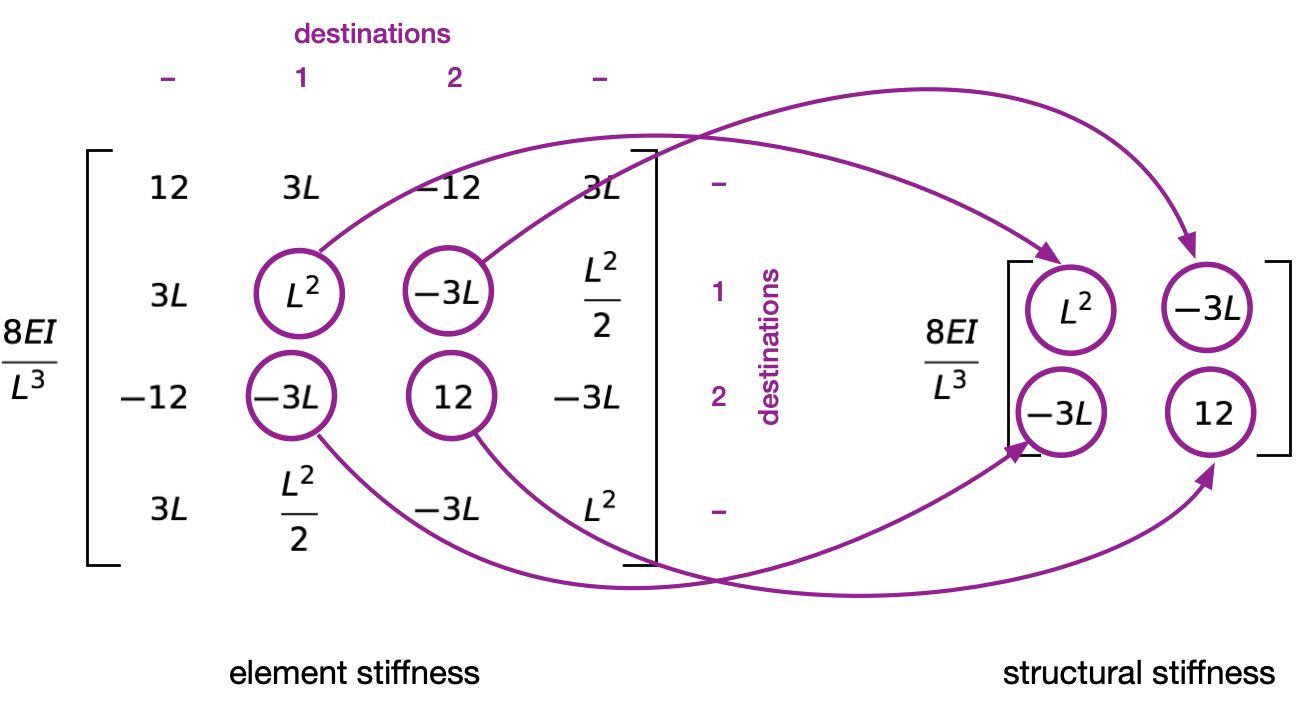
I took a class in matrix structural analysis (CE 361) from Prof. Jamshid Ghaboussi in the fall of 1981. He used the phrase destination array for the list of structural DOF that the element DOF go to. I’ve always thought that was a particularly good description and have used it ever since, even though I don’t think I’ve ever seen it in any finite element textbook. Note again that DOF 1 and 4 in the element have no destination because those displacements are zero in the structure.
When the assembly of both the stiffness matrix and force vector (which is done in a similar way) are complete, we get this equation:
There are different ways to solve this, but because a 2×2 matrix is easy to invert, that’s how I did it. Premultiplying each side by the inverse of gives us
Matrix multiplication gives us
The signs are the opposite of what we’ve seen before because of the directions we used in defining the degrees of freedom. Physically, though, these are the same answers we’ve seen several times.