
Simply supported beam—dummy unit load method
June 5, 2026 at 7:51 AM by Dr. Drang
We’re in the home stretch of this series, so ANIAT will soon go back to complaining about Apple’s UI choices.1 Next week’s WWDC keynote should provide some inspiration.
But today’s post covers our eleventh method for deriving the center deflection of a uniformly loaded simply supported beam: the dummy unit load method. When I was an undergraduate, this was the method we used to determine the deflections of truss structures, but it’s more general than that. My favorite explanation of why it works is in Nicholas J. Hoff’s The Analysis of Structures. I have the original Wiley hardcover of this book, but you can apparently get both paperback and hardcover reprints.
Hoff uses the principle of virtual work in his explanation, and I’d like to quote him here, but unfortunately his explanation is split between one section on the analysis of trusses and another on the analysis of beams. I couldn’t figure out a nice way to put them together coherently, so you’re just going to have to trust me.
For a beam, you can get the deflection at a particular point by following these steps:
- Work out an equation for the bending moment, M, in the beam for the given set of applied loads.
- Imagine that same beam with those loads removed (this is the dummy structure) and a concentrated unit load placed at the point at which we want the deflection. By definition, the magnitude of a unit load is one. The unit load points in the direction of the deflection we want to calculate.
- Work out an equation for the bending moment, m, in the dummy beam with the unit load.
The desired deflection is
Let’s apply this simple principle to our problem:
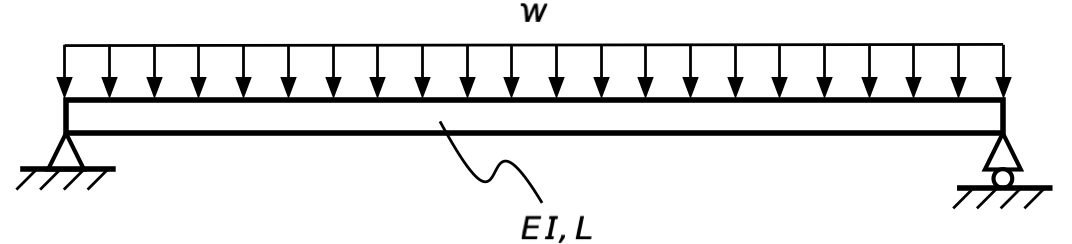
The bending moment is
where the x coordinate starts at the left end of the beam and increases to the right, as usual.
This same structure with just a unit load at the center is
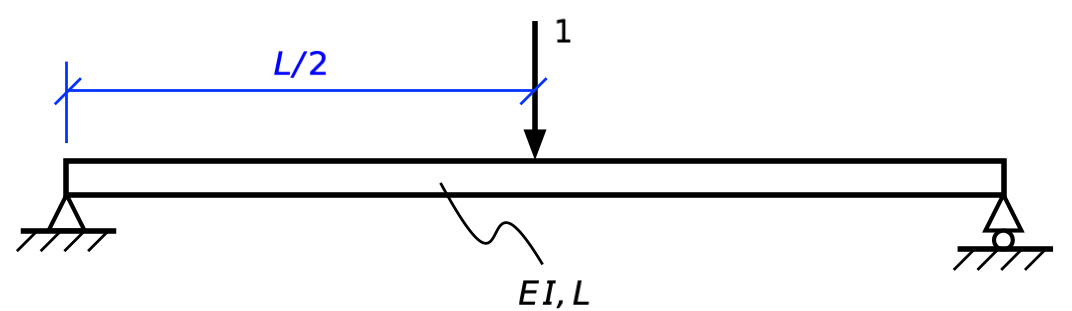
Its bending moment is
and m is symmetric about the center of the beam.
Therefore,
and we can take advantage of symmetry to say
You can pretty much do this problem in your head if you’re good at figuring out least common multiples. I’m not, but after writing things out, I did realize that the LCM of and is .
-
Heads up, though. I recently thought of a thirteenth method that’s different enough from the others to merit another post. Sorry about that. ↩