
Simply supported beam—Newmark’s method
June 6, 2026 at 7:44 AM by Dr. Drang
This would have been the last post in the series if I hadn’t realized recently that another method deserved a post. So this is the penultimate. It was described in this 1943 paper by Nathan Newmark and is known—or was known—as Newmark’s method.
I say was because this method is dead. How dead? Forty-five years ago, when I was an undergraduate taking structural analysis courses, Newmark’s method wasn’t being taught in the department that he had been the head of for decades and whose main building is named after him. That’s dead.
Which isn’t to say it wasn’t a good method. Some of my professors talked about using it when they were young, and it was a practical technique when engineers used slide rules and desk calculators, but it was clear by the 80s that its time had passed. Still, it’s desncribed in the textbook I used as an undergrad, and I did eventually learn it well after I was out of school, so here it is.
Newmark’s method is basically a way of doing double integration, so you can use it to go from loading to bending moments or from bending moments to deflection. As Newmark says in the introduction to his paper,
The numerical procedure is approximate, but leads to exact moments (or deflections) when the loading diagram (or diagram of “angle changes”) is made up of segments that are bounded by straight lines or by arcs of parabolas.
For our simply supported, uniformly loaded beam, the “angle change” diagram—which we’ve been calling a curvature diagram—is a parabola, so we can get an exact solution.
Let’s say we have a beam with any kind of support conditions and some general distributed loading:
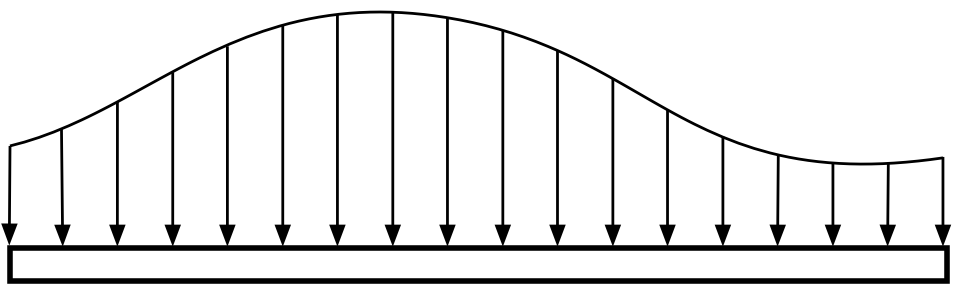
The fundamental trick of Newmark’s method is to imagine a set of simply supported beams inserted between the load and the real beam.
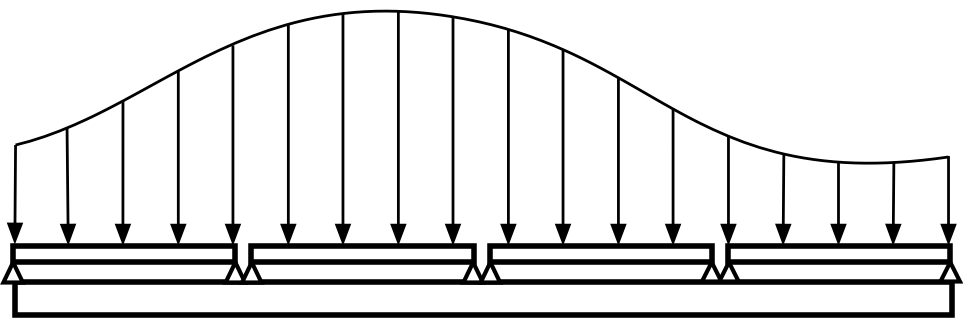
The small imaginary beam segments are all of the same length, , and the analysis proceeds by calculating the reaction forces at the ends of these beams and then building a table of loads, shears, and moments based on these reactions (reversed in direction) acting on the large original beam.
Here’s a figure from the paper that explains how to calculate the reaction forces for parabolically distributed loading:
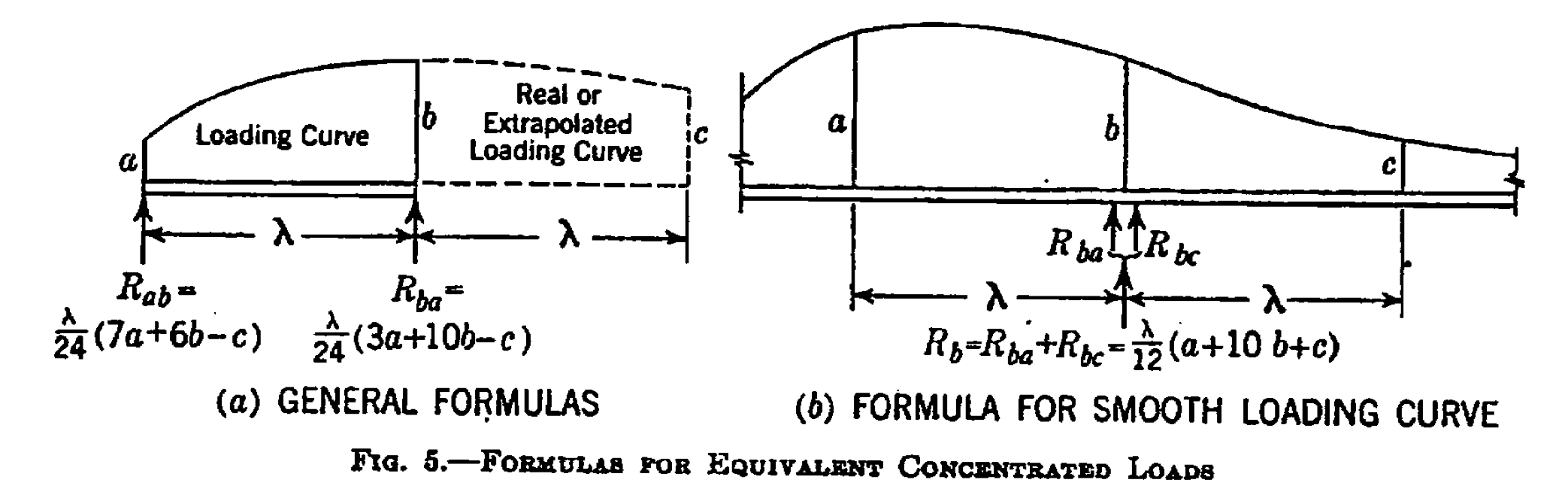
There are simpler formulas if the loading is distributed linearly.
You may have noticed the double curvature in the right drawing, which means that the load shown there is not parabolic. Newmark suggests using the formulas in this figure even if the loading curve is of higher order—the parabolic formulas are close enough if you divide the beam into several segments.
I’ve focused here on the process of going from loads to bending moments because I think the mechanics of that is easier to understand. But the same process applies to going from curvature to deflection. We went through that in the conjugate beam post.
In fact, Newmark does our problem in the paper. He uses the constant q as the intensity of the load and splits the beam into four segments:
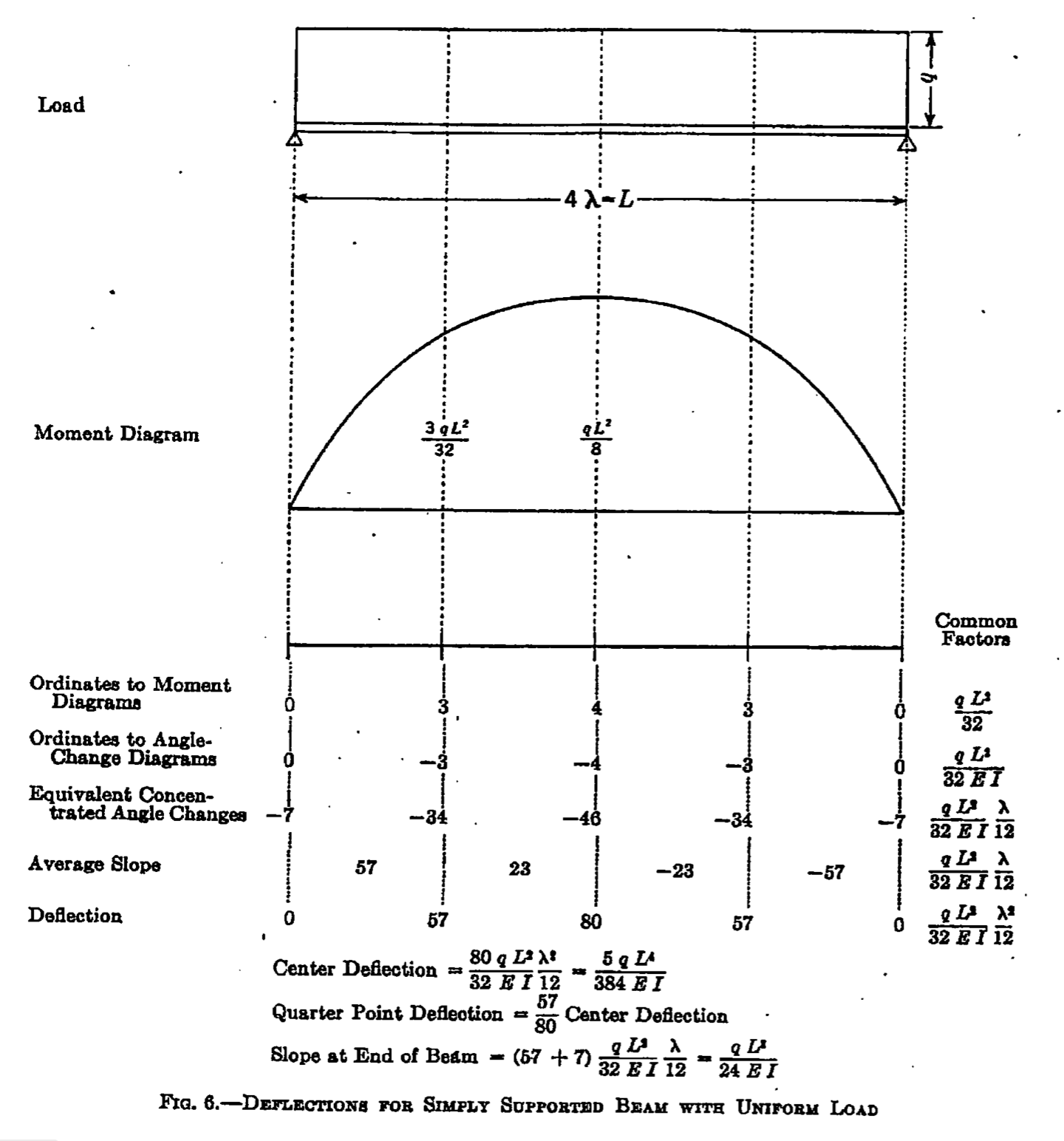
This may look impenetrable, but we can simplify it by using only two segments and explaining each step. Here’s the table, starting with the moment diagram:
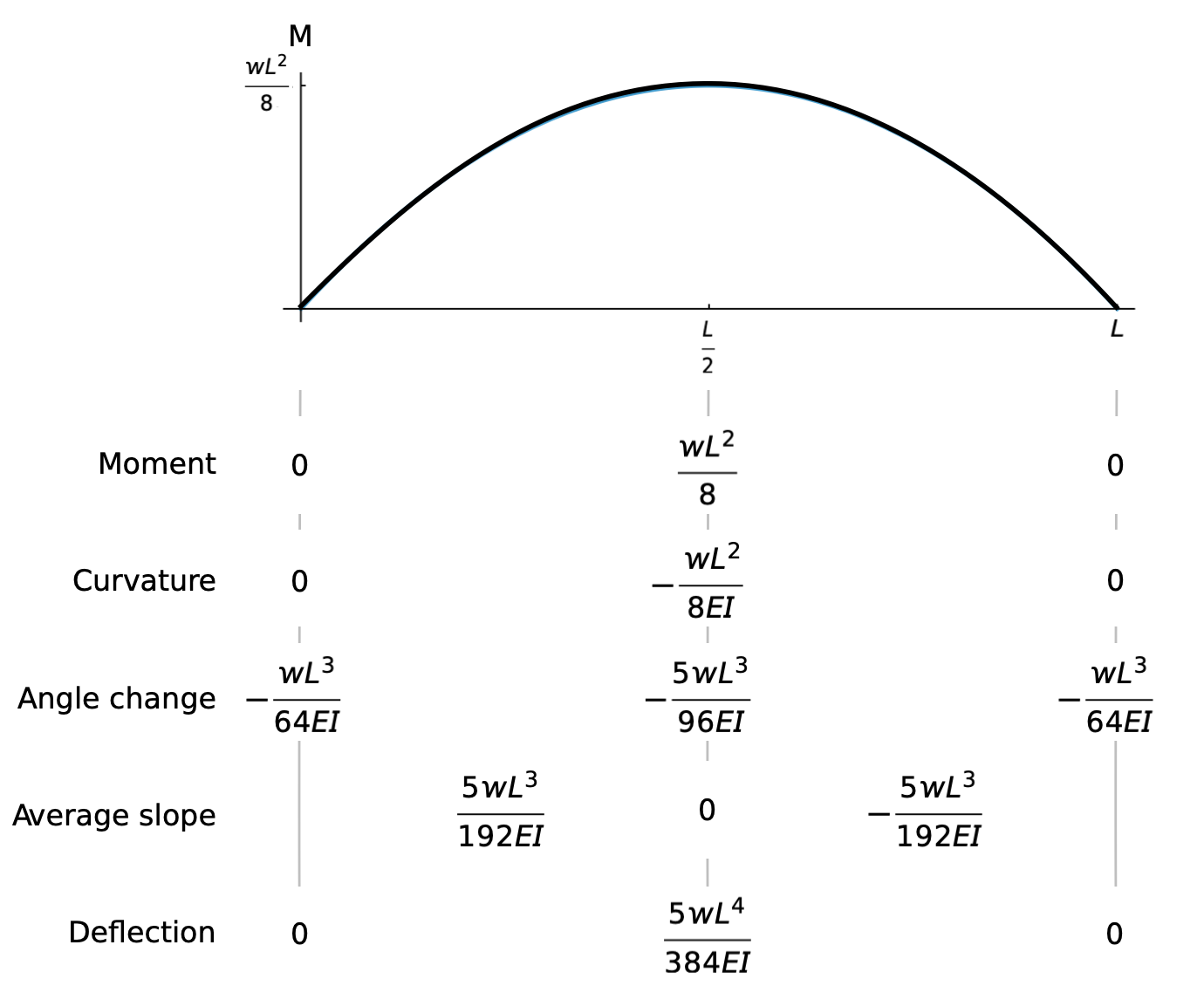
The row labeled Moment is the value of the bending moment at each point. The Curvature row is just the moment at each point divided by EI and with the sign reversed. Those are the easy ones.
The Angle change row is based on the curvature values and the formulas in Figure 5 above. The value at the left end is
where we’ve used . This is also the value at the right end.
The value at the center is
We start the Average slope row with the knowledge that the slope at the center of the beam is zero, so if the angle change across the center is
then the average slope must go from
as we move from the left half of the beam to the right half.
(If you’re having trouble with this, remember that angle change is analogous to shear and think of a beam with an antisymmetric shear diagram. If the change in shear across the centerline is , then the shear must be in the left half of the beam and in the right half.)
For the Deflection row, we know that the deflection is zero at the left and right ends. Since the average slope in the left half of the beam is
the deflection at the center must be
an answer we’ve now seen twelve times.