
Simply supported beam—Fourier series solution of the ODE
June 6, 2026 at 3:36 PM by Dr. Drang
We’re finally here, at the end of all things. In this post, we’ll use a Fourier series to get the formula for the center deflection of a simply supported beam with a uniformly distributed load. We’ll see some of the same math that we saw in the previous Fourier series solution, but the fundamental approach will be different.
Let’s start with the fourth-order ordinary differential equation for a beam with a general loading function, :
The simple supports at both ends give us these boundary conditions:
Let’s work out the solution for a loading condition we haven’t considered before, a distributed load in the form of a sine wave:
where is a positive integer and is some constant amplitude. Given the form of the governing ODE and the boundary conditions, it seems likely that the solution will look like this:
It satisfies the boundary conditions, and if we plug it and the expression for q into the governing ODE, we get
which is a solution for all values of x if
This will work for any value of m that’s a positive integer.
Since the governing ODE is linear, if q is the sum of several sine terms, the solution will be the sum of several sine terms. Returning to our favorite problem,
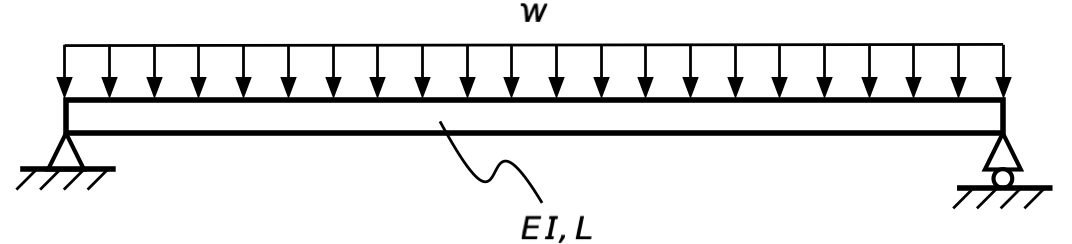
we now have a path for expressing the solution as a sum of sines, as long as we can express the constant function, , as a sum of sines.
And of course we can. The Fourier sine series expression that fits a constant is
where
This result comes from the orthogonality of the sine function. The Fourier coefficients are the same as those for a square wave.
Plugging this result into the expression for , we get
for odd m. Therefore,
You may recall from our earlier post that there’s a closed-form solution for this sum:
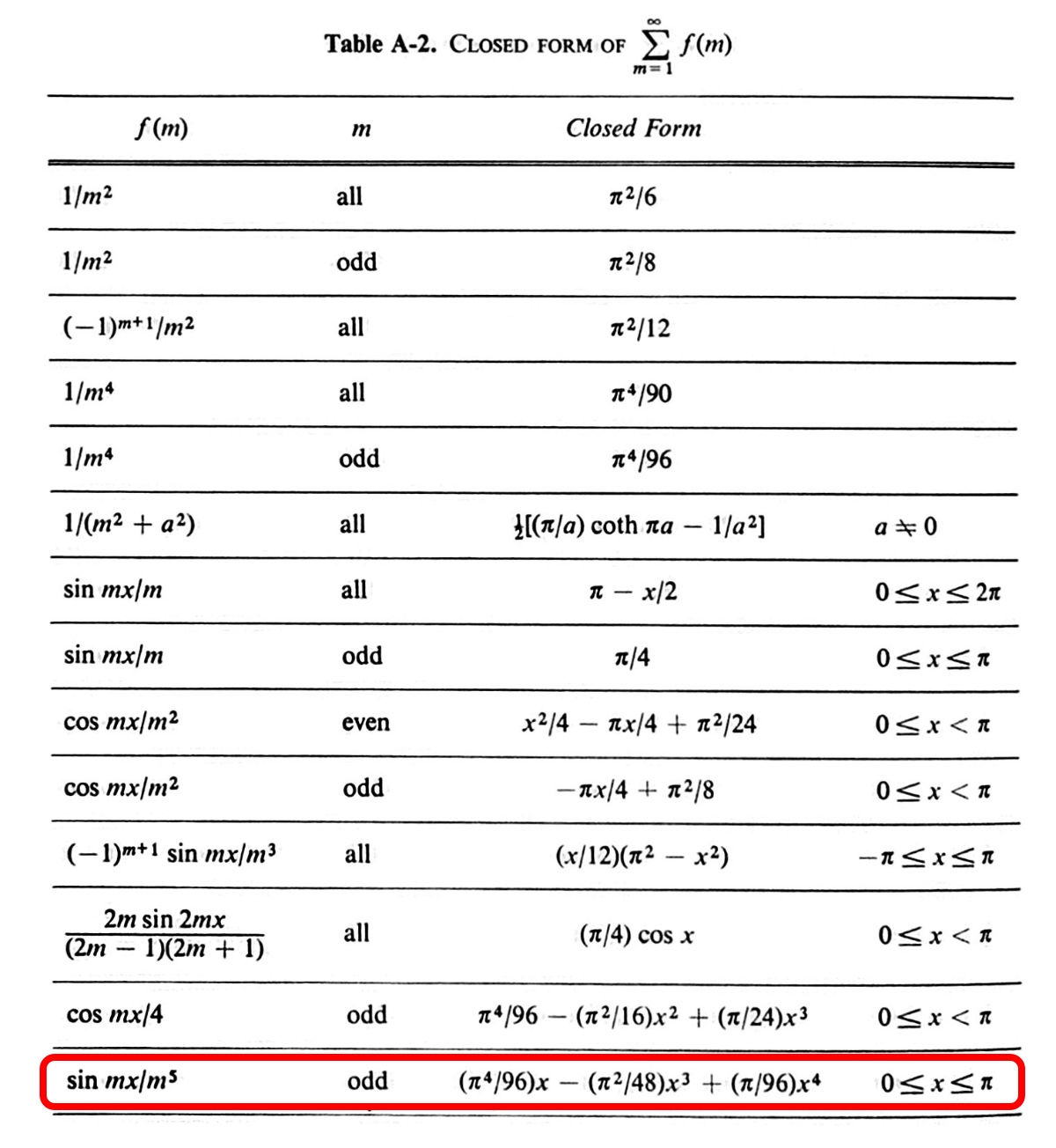
The last entry in this table with gives us
Substituting the closed-form solution in for the sum yields our old friend:
The purpose of this series of posts—apart from a bit of showing off—was to demonstrate why I love structural analysis. It has, even in the simplest of problems, a depth that rewards those who study it. And when you’re confronted with problems that aren’t so simple, you can draw on that depth to understand and solve them.