
Permanent Daylight Saving Time
July 17, 2026 at 12:48 PM by Dr. Drang
A couple of days ago, Casey Liss took a break from arguing about temperature scales to tweak me about the recent passage of the Sunshine Protection Act by the House. The Act would make Daylight Saving Time permanent, something Casey knows I disapprove of. A similar bill passed the Senate a few years ago, and Donald Trump has said he will sign this one, so there’s a decent chance it’ll become law. Let’s see what will happen if it does.
First, of course, there will be a lot of cheering from the people who moan about changing their clocks twice a year. Well, some of the moaners will cheer—the ones who wanted to eliminate DST and stay on Standard Time all year will grumble, but they’ll probably still be pleased to be released from that terrible burden.
I’m more interested in the consequences of permanent DST. You may recall my sunrise/sunset plots. Here’s one for Chicago in 2026:
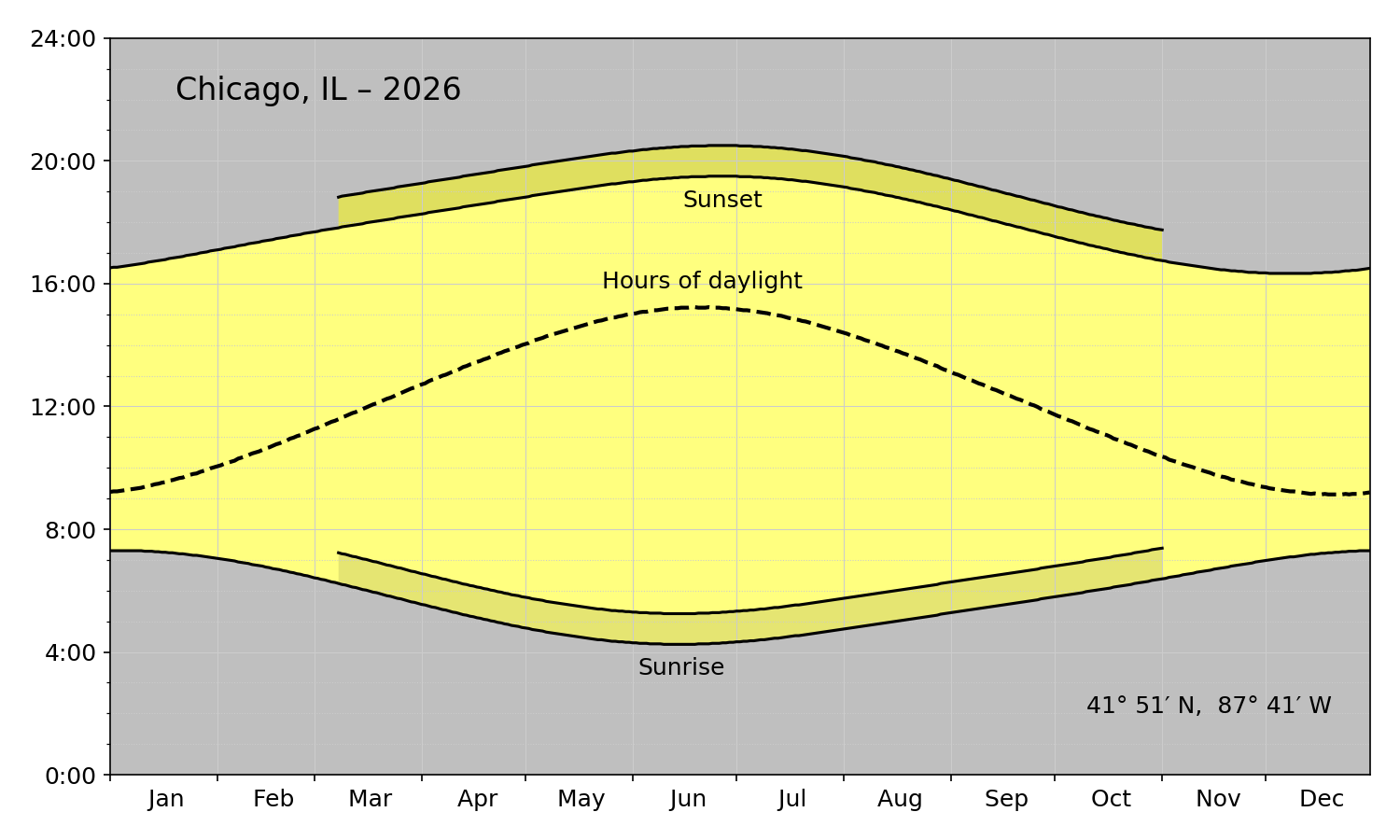
The dirty yellow zones cover the DST period, which currently runs from the second Sunday in March to the first Sunday in November. A small change to the sunplot code extends that zone to the entire year:
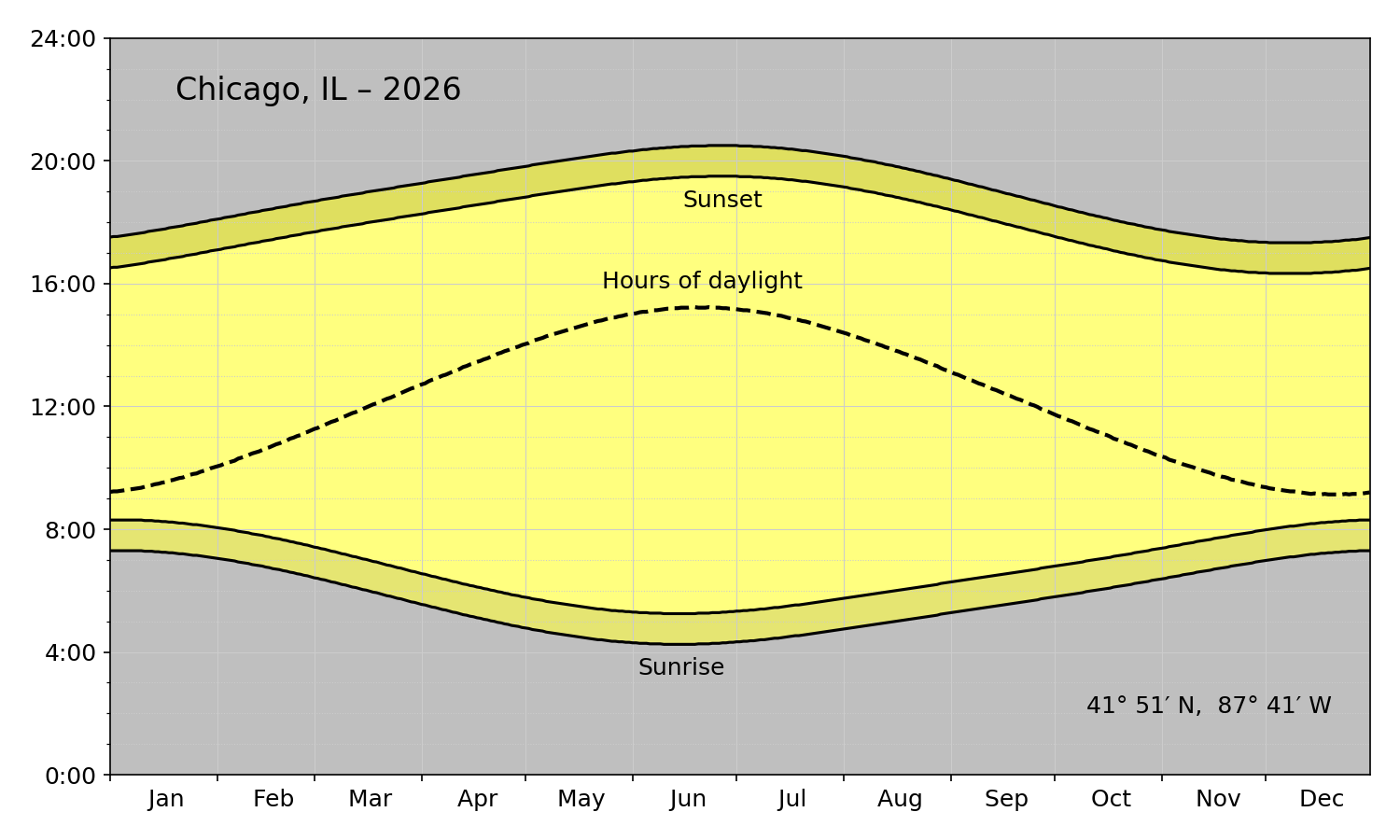
I left the Standard Time lines in place for comparison, even though there won’t be any Standard Time if the Act becomes law.
As you can see, there will be a long stretch—more than two months—for which sunrise will be after 8:00.1 I’m sure this won’t bother many of you who don’t do anything before 8:00, but there are lots of people it will bother. And I bet we’ll hear from them, even though a good chunk of them will be from the current cohort of clock-change moaners.
People living near the western edge of a time zone will have even more morning darkness. You may recall my visit to a Louis Sullivan bank in West Lafayette, Indiana, a couple of weeks ago. My photos showed the sun shining on the north side of the bank, which happened because the sun rises late in West Lafayette. (By “late” I mean in local clock time. You could make an argument that the Sun, like Gandalf, is never late. Nor is it early. It rises precisely when it means to.)
Let’s see the sunrise/sunset times in West Lafayette under permanent DST:
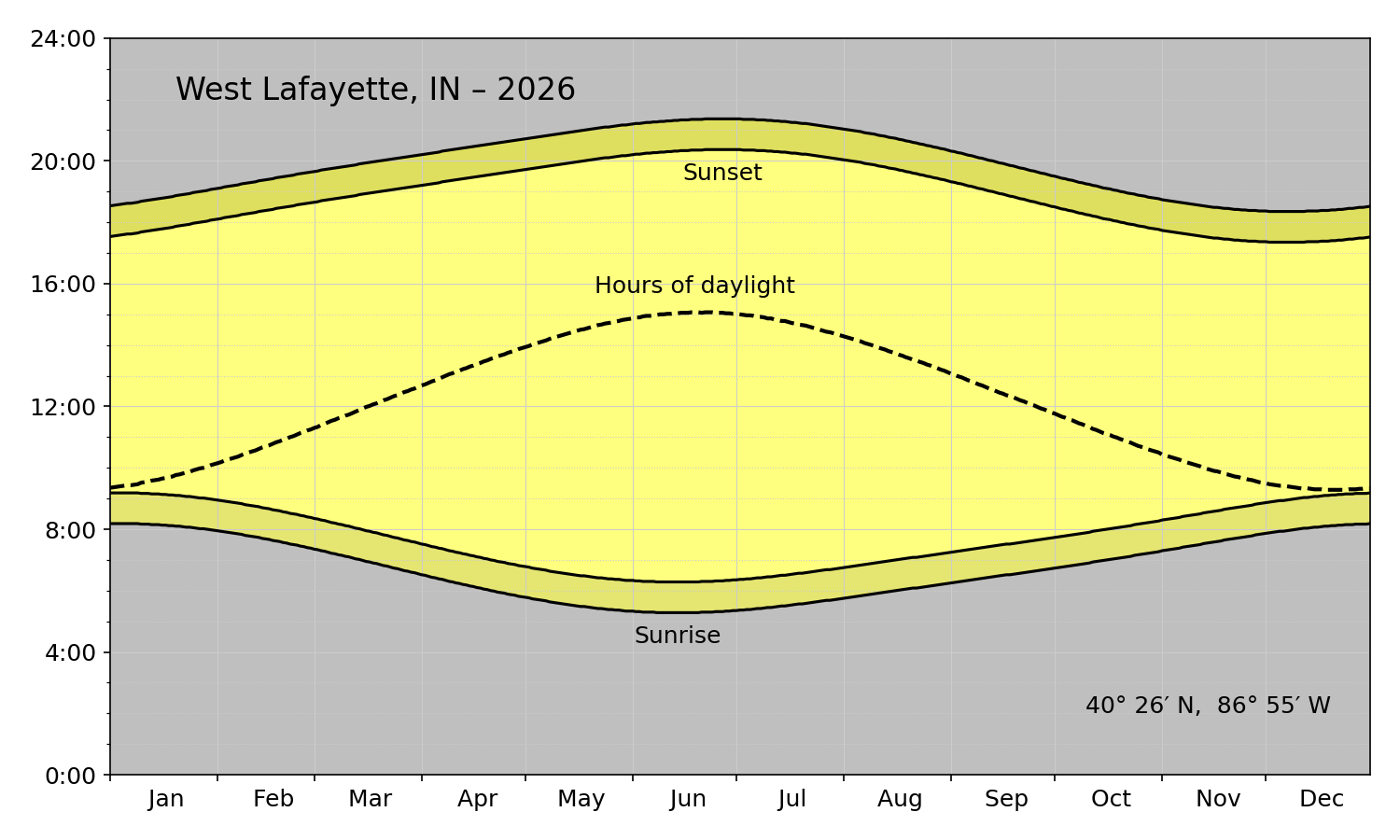
Basically five months for which the sun never rises before 8:00. And about seven weeks for which it doesn’t rise before 9:00. No one deserves that—not even Boilermakers.
Update 29 Jul 2026 4:46 PM
A few days ago, Timothy King pointed out on Mastodon that Michigan’s Upper Peninsula will have even later winter sunrises under DST than western Indiana. Absolutely correct. Most of the UP is on Eastern Time, even some parts that are west of Chicago.
This reminded me that Nathan Grigg wrote a couple of nice posts on the topic that I forgot to link to. The first one has a lovely map of the contiguous US that shows the latest sunrise time under the current DST rules. Permanent DST would put sunrise in Houghton, Michigan, between 9:30 and 10:00. The second post has a map showing which parts of the country are more than 7.5° from the center longitude of their time zones. Except for a tiny portion of Maine, all of these misaligned areas are west of where their time zone would end if time zones were governed strictly by longitude.
I meant to add an update like this right after Nathan wrote his posts, but it slipped my mind. Thanks to Timothy for reminding me, and apologies to Nathan for being tardy.
-
Yes, the graph is just for 2026, but sunrise times don’t change all that much from year to year. ↩